Manufactured in Greater NoidaGenuine Philips UV-C LampsIIT Patna Alumni on Our TeamExporting to 20+ Countries
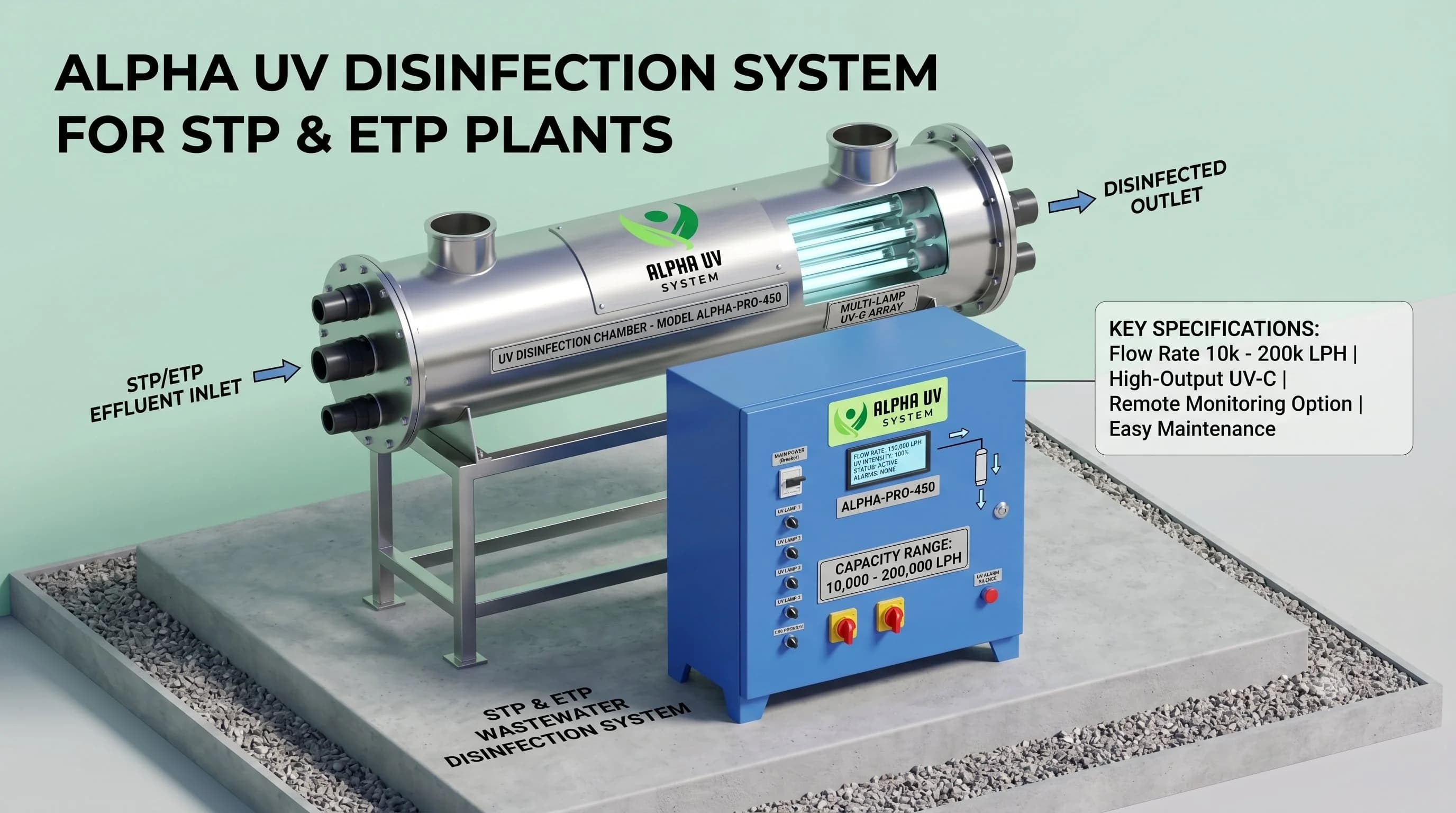
Chemical-free tertiary disinfection for STP and ETP plants – from small residential societies (10,000 LPH) to large municipal plants (2,00,000 LPH). Philips UV-C lamps, SS316L chambers, and CPCB-compliant UV dose calculations by IIT Patna-trained engineers.
UV Dose
40–100 mJ/cm²
Capacity
10,000 – 2,00,000 LPH
In a conventional sewage treatment plant, wastewater passes through primary sedimentation, biological treatment (activated sludge or SBR), and secondary clarification before discharge. UV disinfection is the tertiary treatment stage — the final barrier before treated effluent is discharged to surface water, reused for irrigation, or recycled within the plant.
UV-C light at 254 nm penetrates the cell walls of bacteria, viruses, and protozoa — including E. coli, Salmonella, Cryptosporidium, and Giardia. It disrupts their DNA and RNA, permanently preventing reproduction. Unlike chlorine, UV disinfection does not create disinfection byproducts (DBPs) like trihalomethanes (THMs) — a critical advantage for effluent that will be reused in residential, industrial, or agricultural contexts.
The key performance metric is UV dose, measured in millijoules per square centimetre (mJ/cm²). For STP effluent discharge, CPCB guidelines require a minimum dose of 40 mJ/cm² to achieve total coliform reduction to less than 100 MPN/100 mL. For effluent reuse in irrigation or toilet flushing, the recommended dose is 80–100 mJ/cm² to meet less than 10 MPN/100 mL.
UV dose delivery depends on three factors: lamp UV-C output, flow rate through the chamber, and the UV transmittance (UVT) of the water. STP effluent typically has a UVT of 55–75% at 254 nm — significantly lower than drinking water (85–95%). This is why Alpha UV System uses Philips UV-C lamps for STP applications — they produce substantially higher UV-C output than standard low-pressure lamps, compensating for the reduced transmittance of secondary-treated sewage.
Alpha UV System's IIT Patna-trained engineers calculate the required UV dose from your actual water quality parameters — measured UVT, turbidity, and target log reduction — before specifying any system. This is not a catalogue lookup. It is engineering from first principles.
The effectiveness of UV disinfection is not a chemical approximation — it is a direct photochemical interaction between UV-C photons and the molecular structure of pathogen DNA and RNA. Understanding this mechanism is essential for engineers and facility managers specifying UV systems for STP tertiary treatment, because the same mechanism explains both the power and the precise limits of UV technology.
DNA absorbs UV-C radiation most strongly between 250 and 265 nm, with peak absorption at 254 nm. This is not coincidental: the purine and pyrimidine bases that form the structural rungs of the DNA double helix — adenine, thymine, guanine, cytosine — have electronic resonance frequencies that correspond precisely to this wavelength range. When a UV-C photon at 254 nm is absorbed by a thymine or cytosine base, it excites the base's electron cloud and drives the formation of a covalent bond between adjacent identical bases on the same DNA strand — a photodimer, most commonly a cyclobutane pyrimidine dimer (CPD) or 6-4 photoproduct.
These photodimers distort the physical geometry of the DNA double helix. The replication machinery of the cell — specifically, DNA polymerase — cannot process this distortion. Replication halts. The bacterium cannot divide. Viruses cannot produce new viral particles. Protozoan cysts cannot germinate. None of these organisms are destroyed in the conventional sense: their structural integrity remains intact. But their ability to reproduce — and therefore to cause infection — is permanently eliminated at the UV doses typical of water treatment.
Critically, Cryptosporidium parvum oocysts and Giardia lamblia cysts — protozoan parasites responsible for significant waterborne disease burden in India — are completely resistant to chlorine at practical disinfection doses. The WHO Guidelines for Drinking Water Quality (4th Edition) documents that Cryptosporidium requires 10 mg/L chlorine for 2 hours to achieve 2-log inactivation — an impractical condition for any operating STP. UV-C at 40 mJ/cm² achieves 3-log (99.9%) inactivation of Cryptosporidium, making UV the only viable disinfection technology for STPs whose treated effluent enters water bodies used for recreation or as downstream drinking water intake.
The absence of chemical residuals is the defining advantage of UV disinfection for reuse applications. Chlorine-treated effluent must be dechlorinated before discharge to surface water bodies to protect aquatic ecosystems — an additional process step and cost that UV completely eliminates. For India's rivers under the National Mission for Clean Ganga (NMCG), chemical-free treatment of STP effluent is not merely a preference — it is an ecological imperative.
India's regulatory framework for STP effluent is anchored in the Environment Protection Act, 1986, administered by the Central Pollution Control Board (CPCB). The General Standards for Discharge of Environmental Pollutants (Schedule VI) specify microbiological limits for treated STP effluent discharging to inland surface waters, irrigation, and public sewers.
For STP effluent discharge to inland surface water bodies, CPCB MINAS (Minimum National Standards) require:
For treated effluent intended for reuse — toilet flushing, landscaping, industrial cooling, construction — the 2017 Central Ground Water Authority guidelines specify:
State Pollution Control Boards in Maharashtra, Karnataka, Tamil Nadu, and Delhi are actively enforcing STP microbiological compliance for residential societies, industrial parks, and campuses with STP capacity above 10 KLD. The National Green Tribunal's orders in 2019, 2021, and 2023 directed SPCBs to impose penalties on non-compliant STPs and require third-party microbiological monitoring at all STPs serving high-density residential areas.
The CPHEEO Manual on Sewerage and Sewage Treatment Systems (2013) — prepared by the Ministry of Housing and Urban Affairs — recommends UV disinfection as the preferred tertiary treatment technology for STPs of all scales. The manual specifically requires UV dose calculation using the Reduction Equivalent Dose (RED) methodology, which accounts for hydraulic non-idealities in the UV chamber. Alpha UV System engineers follow CPHEEO RED methodology for all STP UV dose calculations, ensuring the dose calculation represents actual dose delivery — not an optimistic theoretical value.
For Alpha UV System customers, regulatory compliance requires: a UV dose calculation report prepared by a qualified engineer; a UV intensity monitor with alarm that triggers below the minimum required level; records of lamp replacement dates, intensity readings, and alarm events available for SPCB inspection; and CPCB-formatted documentation packages for facility audit.
UV dose in a flowing water system is the product of UV-C intensity (mW/cm²) and exposure time (seconds) as water passes through the UV chamber. But this simplified equation does not account for the real-world factors that reduce the effective dose delivered to pathogens in STP secondary-treated effluent.
UV Transmittance (UVT): STP secondary-treated effluent typically has UVT values of 55–75% at 254 nm, compared to 85–95% for treated drinking water. UVT of 65% means 35% of UV-C energy is absorbed per centimetre of water path. At higher flow rates or in chambers with larger diameters, water at the far edge of the lamp's UV field may receive substantially less dose than the central water. IIT Patna-trained engineers measure UVT from actual effluent samples before specifying any system. A water sample from your STP is all that is needed to begin an accurate calculation.
Hydraulic Non-Ideality (System RED Factor): Real UV chambers do not have perfect plug-flow hydraulics. Recirculation zones, short-circuiting pathways, and velocity variations create a distribution of exposure times. Water molecules taking the fastest path through the chamber receive the minimum dose. The Reduction Equivalent Dose (RED) factor quantifies this non-ideality: a system with RED factor 0.80 delivers 80% of the theoretical dose to the fastest-path water. Alpha UV System uses validated chamber geometries with RED factors of 0.75–0.88 depending on flow velocity. The USEPA UV Disinfection Guidance Manual (EPA 815-R-06-007) describes the Biodosimetry validation methodology used to establish RED factors for each chamber design.
End-of-Lamp-Life (ELL) Intensity: Philips UV-C lamps lose output progressively over 9,000 rated hours, reaching approximately 80% of initial output at end of life. The dose calculation must use end-of-life (ELL) intensity, not new-lamp intensity, to ensure the system remains compliant through the full lamp replacement interval. Using new-lamp intensity in the calculation would result in non-compliance during the final months of the lamp's service life.
Quartz Sleeve Fouling Factor: Iron, calcium, and organic deposits accumulate on quartz sleeves. For STP effluent, a sleeve fouling factor of 0.90 is typical with auto-wiper fitted, and 0.85 without. This factor must be included in the dose calculation to ensure real-world compliance. Alpha UV System's SS316L auto-wiper mechanism maintains sleeve cleanliness continuously, with quarterly chemical descaling using citric acid solution to remove mineral scale.
The combined effect of these factors means that for STP effluent at UVT 65%, achieving a RED of 40 mJ/cm² requires approximately 8–12× the lamp UV-C output needed for drinking water at UVT 90%. This is precisely why lamp selection and chamber hydraulics are engineering decisions — not catalogue choices.
UV disinfection is a microbiological treatment technology — it does not reduce BOD, TSS, turbidity, or dissolved organic load. It operates as the final treatment stage on biologically-treated, clarified effluent. The secondary treatment process must produce effluent meeting minimum quality parameters before the UV stage can reliably achieve CPCB microbiological compliance.
Turbidity and Total Suspended Solids: TSS above 30 mg/L causes particle shielding — microorganisms embedded within or sheltered by suspended particles are physically protected from UV-C radiation. A sand filter or dual-media (anthracite + sand) filter ahead of the UV chamber reduces TSS to below 10 mg/L. This is also the CPCB reuse standard for TSS, so the filtration step serves dual compliance purposes. Tertiary clarification with tube settlers or lamella plates achieves equivalent TSS reduction for high-SS secondary clarifier effluent.
UV Transmittance: UVT below 55% — which can occur in effluent from textile processing, coffee processing, or distillery wastewater mixed with domestic sewage — requires substantially higher lamp UV-C output to achieve the target dose. An activated carbon polishing filter raises UVT by adsorbing dissolved organic colour. Coagulation-flocculation ahead of the filter removes colloidal particulates that absorb UV-C. For most domestic STP effluent after biological treatment, UVT will be 60–75% without additional treatment.
Iron and Manganese: Dissolved ferrous iron (Fe²�?�) above 0.3 mg/L absorbs UV-C directly at 254 nm. This is particularly relevant for ETPs processing iron-containing industrial wastewater — metal finishing, electroplating, steel pickling. Aeration followed by sand filtration removes dissolved iron by oxidation and precipitation before the UV chamber.
pH and Temperature: UV disinfection performance is largely independent of pH (unlike chlorination, which is strongly pH-dependent). Temperature affects lamp output — at lower temperatures (below 20°C), low-pressure lamp output may decrease by 5–10%. This is relevant for cold-region STP installations in Himachal Pradesh, Uttarakhand, Jammu, and Kashmir, where winter effluent temperatures can approach 10–15°C.
STP UV systems are installed at residential housing societies, institutional campuses, industrial parks, hospitals, hotels, and municipal treatment plants across India. Each application has different design requirements: a residential society STP running 50–100 KLD at 16 hours/day needs a different configuration than a continuous-operation industrial STP at 1 MLD or a municipal plant maintaining CPCB compliance for public health.
For residential housing societies under Haryana RERA and similar state mandates requiring treated water reuse for landscaping and toilet flushing, the UV system must achieve the stricter 10 MPN/100 mL standard at 80–100 mJ/cm². For hotels and resorts where treated water is reused for cooling tower make-up or irrigation, the same standard applies. For industrial ETP discharge to municipal drains or surface water bodies, the 40 mJ/cm² standard for 100 MPN/100 mL compliance is the regulatory minimum — but many SPCBs are now moving toward stricter microbiological requirements for industrial discharge.
Alpha UV System has supplied STP UV systems across Delhi NCR, Noida, Greater Noida, Gurugram, Faridabad, Ghaziabad, and to sites in Maharashtra, Gujarat, Karnataka, Tamil Nadu, Rajasthan, and Uttar Pradesh. Each installation comes with complete CPCB/SPCB documentation packages, including UV dose calculation reports prepared and signed by IIT Patna-trained engineers.
In Bengaluru, where the Karnataka State Pollution Control Board has intensified STP compliance audits for residential apartments under RERA requirements, UV disinfection with documented dose calculations has become the standard approach for demonstrating microbiological compliance. Similar regulatory intensity is visible in Pune (Maharashtra PCB), Hyderabad (Telangana PCB), and Chennai (Tamil Nadu PCB), where NGT orders have required apartment complexes and industrial campuses to demonstrate STP microbiological performance with third-party test reports.
India's National Water Policy (2012) and the NITI Aayog's Composite Water Management Index (2019) identify treated wastewater reuse as a critical strategy for reducing freshwater stress in India's water-scarce urban centres. The UN-Water SDG 6 (Clean Water and Sanitation) target 6.3 specifically requires improving water quality globally by halving the proportion of untreated wastewater and substantially increasing recycling and safe reuse.
For STP treated effluent disinfected to less than 10 MPN/100 mL total coliforms — achievable at 80–100 mJ/cm² UV dose — the following reuse applications comply with Indian and international standards:
Landscape and horticultural irrigation: Under BIS IS 16162:2014 (Part 1), treated recycled water meeting microbiological limits is approved for restricted irrigation of parks, highway verges, and non-edible crop agriculture. WaterAid India estimates that 30–40% of water consumption in large residential townships is for landscaping. Treated STP effluent can replace this potable water demand entirely, reducing the township's municipal water consumption and the SPCB-regulated groundwater abstraction.
Toilet flushing: BIS IS 16162:2014 (Part 2) approves treated recycled water for toilet flushing in dual-plumbing buildings. RERA mandates in Haryana, Maharashtra, Karnataka, and Telangana now require builders to install STP with reuse plumbing for residential developments above 20,000 m² built-up area. A 100-flat residential society reusing STP effluent for toilet flushing reduces potable water consumption by 20–25%.
Cooling tower make-up water: Industrial facilities with cooling towers can use treated STP effluent as make-up water — reducing freshwater withdrawal and effluent disposal costs simultaneously. Additional treatment (scale inhibitor, biocide for Legionella control) is required, but this is standard at industrial facilities. The cooling tower make-up application is particularly valuable for industrial campuses in water-stressed regions such as Maharashtra's Vidarbha, Gujarat's Saurashtra, and Tamil Nadu's Coimbatore district.
Construction water: Dust suppression, road compaction, and concrete curing on large construction sites can use STP treated effluent, reducing reliance on water tankers — whose groundwater extraction is now regulated by state groundwater authorities across India.
UV disinfection has become the dominant technology in municipal wastewater treatment globally. The International Water Association (IWA) reports in its Wastewater Report (2022) that UV disinfection now treats more than 50% of municipal wastewater by flow volume in the United States, Canada, Australia, and across Scandinavia — markets where chlorination was the previous standard but was phased out due to trihalomethane formation and chlorinated compound discharge to ecologically sensitive receiving water bodies.
The USEPA's National Pollutant Discharge Elimination System (NPDES) permit conditions now explicitly restrict chlorine residuals in wastewater discharged to freshwater streams across most US states, effectively mandating UV or ozone as the only viable compliance pathway for surface-water discharge permits. This regulatory pattern — driven by ecological protection rather than public health concerns — mirrors the trajectory India is following through CPCB's tightening of STP discharge standards and NGT orders restricting chemically treated effluent discharge to Class A rivers.
Japan's Ministry of Land, Infrastructure, Transport and Tourism mandates UV disinfection at all STPs discharging to rivers within the Tokyo Bay and Osaka Bay watershed areas, where combined bacterial pollution historically caused closures of recreational bathing beaches. The measurable improvement in bay water quality over 2000–2020 is attributed substantially to the transition from chlorination to UV at STPs — a case study that Indian river basin authorities are increasingly citing in river restoration planning under the National River Conservation Plan. Published results in the Water Research journal (Elsevier) document similar water quality improvements in European rivers following the phased replacement of chlorination with UV at tributary STPs.
A UV disinfection system for an STP is installed either as an open-channel UV system in a concrete channel, or as a closed-vessel UV system in a SS316L or HDPE pipeline. The choice depends on STP layout, flow range, and diurnal flow variability.
Open-channel UV: Suited for large STPs above 500 KLD where the treated effluent flows by gravity from secondary clarifiers through a concrete channel to a pump sump or outfall. Multiple UV modules are mounted across the channel width in a submerged rack configuration, with quartz sleeve lamps immersed directly in the effluent flow. Flow variation is managed by lamp ballast dimming or by taking modules offline during low-flow periods.
Closed-vessel UV: Alpha UV System's SS316L closed-vessel UV systems are the standard solution for residential society and institutional campus STPs (50–500 KLD), industrial ETP units, and standalone reuse systems. The vessel is installed in the pipeline between the secondary clarifier outlet and the treated effluent collection sump. The UV system flow rate specification must match the maximum pump output with appropriate margin.
Commissioning checklist: UV intensity sensor calibration with reference radiometer at commissioning and after each lamp replacement. Flow rate verification against design conditions using a clamp-on ultrasonic flow meter. Alarm trip test to confirm panel alarm and relay output below threshold intensity. SCADA integration test for the 4–20 mA UV intensity output signal. Initial microbial sampling — total coliforms and fecal coliforms before and after the UV chamber at commissioning flow rate. All commissioning data recorded in a UV performance commissioning report prepared by an IIT Patna-trained engineer and signed for inclusion in the CPCB compliance documentation package.
The long-term performance of a UV system for STP applications depends on three routine maintenance activities, all of which can be performed by an STP operator without specialised training.
Lamp replacement at 9,000 hours: Philips UV-C lamps are rated to deliver a minimum of 80% of initial UV-C output at 9,000 operating hours. The Alpha UV System control panel displays cumulative lamp-hours and triggers both a visual and audible alarm when output falls to the 80% threshold — the end-of-life alarm set-point established at commissioning. Lamp replacement is the only scheduled maintenance requiring an Alpha UV System service visit or a spare lamp from the Alpha UV System spare parts programme.
Quartz sleeve cleaning: For STP effluent with iron, manganese, or calcium, the auto-wiper mechanism sweeps the sleeve surface on a configurable timer (every 1–4 hours). A quarterly chemical cleaning with dilute citric acid (5–10% solution) removes mineral scale that accumulates between wiper passes. Sleeve inspection at each lamp replacement identifies physical damage (frosting, cracking) that reduces UV-C transmission.
UVT monitoring: Quarterly measurement of UV transmittance on the effluent entering the UV system — using a bench-top spectrophotometer at 254 nm, or a portable UVT meter — verifies that secondary treatment performance has not degraded. A UVT decline of more than 5% from the commissioning baseline is a signal to investigate secondary treatment and adjust pre-treatment. Monitoring and logging UVT data builds the performance record required for SPCB third-party audit compliance under NGT-directed monitoring programmes.
For facilities with SCADA integration, the 4–20 mA UV intensity signal from the Alpha UV System control panel can be logged automatically, providing a continuous, tamper-evident record of UV system performance for regulatory audit purposes.
Recommended Products
IIT Patna engineers recommend these systems for stp & etp uv applications based on flow rate, required UV dose, and compliance standard. Both systems use genuine Philips UV-C lamps and ship with complete compliance documentation.
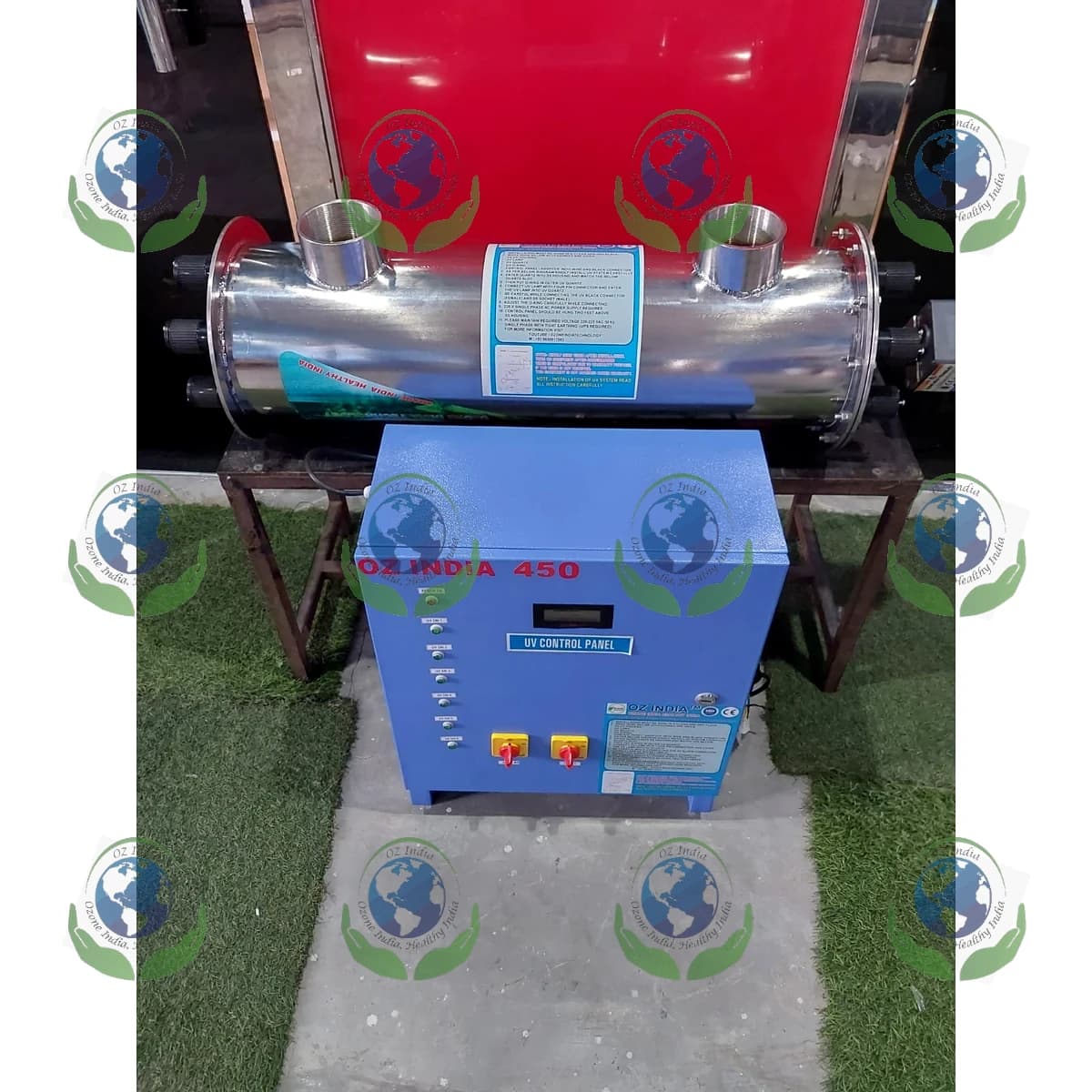
Multi-lamp UV-C closed-vessel system for STP final effluent disinfection. CPCB less than 100 MPN/100 mL compliant. Open-channel configuration for large municipal STPs above 500 KLD. IIT Patna engineered.
High-flow UV-C disinfection for industrial ETP final effluent before discharge or ZLD reuse. Handles higher turbidity and colour loads than STP. Multi-lamp array, SS316L, auto-wiper quartz sleeve cleaning. CPCB and State PCB compliant. IIT Patna engineered.
IIT Patna Engineering
Alpha UV System IIT Patna engineers calculate UV dose from your actual water quality parameters — measured UVT, flow rate, target log reduction, and the specific compliance standard that governs your facility. Not from catalogue sizing tables or generic assumptions. Every system ships with a signed UV dose calculation report, a Philips certificate of authenticity, and compliance documentation prepared for the regulatory framework applicable to stp & etp uv operations.
From measured UVT, flow rate, and target log-reduction. Signed by IIT Patna engineer.
CPCB · SS316L Chamber · MSME Registered · Auto-Wiper Available — documentation prepared to the audit checklist, not generic templates.
WhatsApp your flow rate, water quality, and compliance requirement — engineering-backed quote in 2 hours.
Mon–Sat · 9 AM–6 PM IST · IIT Patna alumni on call
Send us your flow rate and compliance requirement — quote with engineering rationale in 2 hours.
+91 93183 05878
Get Quote →
Call Direct
+91 95995 00580
Tap to Call →
Send Enquiry
Detailed specifications form
Open Form →
