Manufactured in Greater NoidaGenuine Philips UV-C LampsIIT Patna Alumni on Our TeamExporting to 20+ Countries
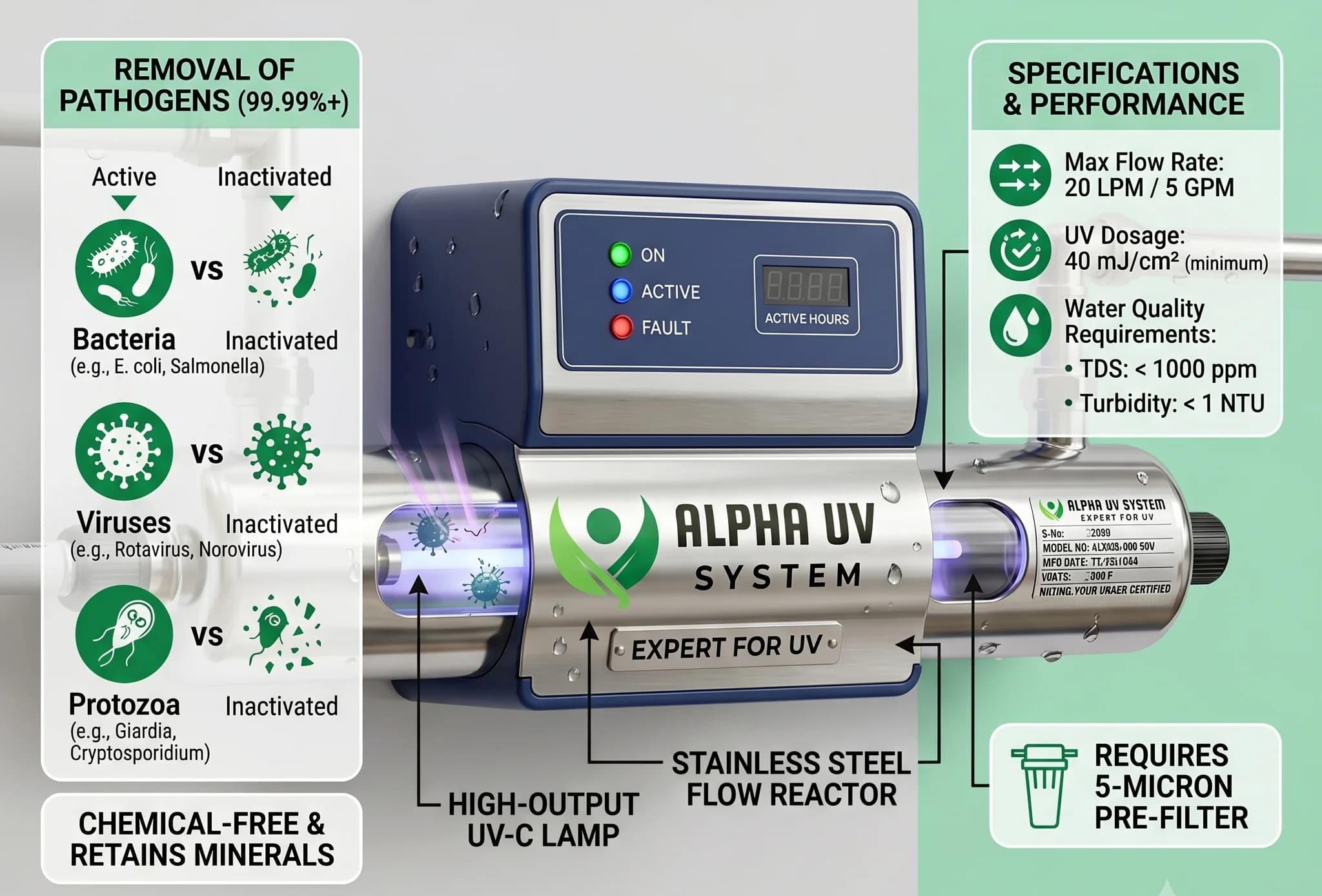
Safe drinking water without chlorine taste, chemical storage, or disinfection byproducts. Philips UV-C lamps deliver 40+ mJ/cm² — the WHO and BIS IS 10500 standard for 4-log pathogen inactivation — from homes (100 LPH) to municipalities (50,000 LPH).
UV Dose
40 mJ/cm²
Capacity
100 – 50,000 LPH
UV-C light at 254 nanometres is absorbed by the DNA and RNA of waterborne microorganisms. The absorbed photon energy causes pyrimidine dimers — predominantly thymine-thymine dimers — to form in the genetic material, permanently disrupting the microorganism's ability to replicate. A pathogen that cannot reproduce is functionally inactivated and cannot cause infection, even if it remains physically present in the water.
The critical engineering parameter is UV dose, expressed in millijoules per square centimetre (mJ/cm²). Dose is the product of UV intensity (mW/cm²) and exposure time (seconds) as the water transits the UV chamber. Alpha UV System designs each reactor so that every parcel of water receives the minimum validated dose of 40 mJ/cm² — the threshold specified by WHO Guidelines for Drinking Water Quality (4th Edition, 2017) and BIS IS 10500:2012 — even at the maximum rated flow rate and at end of lamp life when UV-C output has declined by 15% from initial value.
This design margin is not conservative caution — it is the USEPA UV Disinfection Guidance Manual (EPA 815-R-06-007, 2006) methodology, which mandates that dose validation occurs at minimum UVT, maximum flow, and end-of-lamp-life conditions simultaneously. Hijnen, Beerendonk, and Medema's landmark review in Water Research 40 (2006) 3–22 — the most comprehensive UV dose-response dataset assembled — forms the scientific basis for these thresholds.
India's Central Pollution Control Board (CPCB) 2022 Water Quality Index report classified 45% of monitored water bodies as non-compliant with drinking water parameters for coliform bacteria. The WHO/UNICEF Joint Monitoring Programme (JMP) 2023 report identified India as having 163 million people without safely managed drinking water services — the largest number of any country globally.
The contamination pathway is well established in Indian urban settings: chlorine residuals in municipal distribution mains are frequently depleted before water reaches overhead tanks, particularly in high-rise buildings and long distribution networks. A 2019 study in the International Journal of Environmental Research and Public Health testing tap water samples across six Indian cities found E. coli present in 38% of samples despite prior chlorination — demonstrating that end-of-tap chlorine residual is an unreliable safeguard at the point of consumption.
UV disinfection installed at the point of entry or point of use addresses this problem directly. It operates independently of upstream chlorine residual, adds nothing to the water, and inactivates all waterborne pathogens — including chlorine-resistant Cryptosporidium and Giardia, for which UV requires only 1.5–5 mJ/cm² compared to the 80+ mg/L·min contact time chlorine would need for equivalent inactivation (WHO GDWQ, 2017, Chapter 7).
Chlorination dominated drinking water disinfection for a century because it provided a measurable, distributable residual. For large municipal systems with extended distribution networks, that residual remains an engineering advantage for protecting water in distribution pipes after treatment. But at the point of use — households, apartments, commercial buildings, food processing plants — the calculus changes entirely.
Disinfection byproducts (DBPs) are the critical concern. Chlorine reacts with natural organic matter (humic and fulvic acids) in source water to form trihalomethanes (THMs) — primarily chloroform — and haloacetic acids (HAAs). The International Agency for Research on Cancer (IARC Monograph 84, 2004) classifies chloroform as a Group 2A probable human carcinogen. Long-term exposure to chlorinated drinking water has been associated with elevated risk of bladder and colorectal cancer in multiple epidemiological studies, including the pooled analysis by Villanueva et al. in Environmental Health Perspectives (2004).
UV produces none of these compounds. The only photochemical products in UV-treated water are the inactivated microorganisms themselves — structurally present but biologically harmless.
Taste and odour are secondary but practically significant for consumer acceptance. A 2017 consumer survey by the Indian Council of Medical Research found that chlorine taste was the primary reason cited by 62% of urban households for not drinking directly from the tap, driving dependence on expensive packaged water. UV treatment eliminates this barrier — treated water is organoleptically identical to untreated water, with only the biological hazard removed.
UV disinfection effectiveness depends on the optical clarity of the water. UV-C light can be absorbed or scattered by suspended particles, dissolved iron, manganese, and natural colour compounds before it reaches the target microorganism. The parameter that quantifies this is UV Transmittance (UVT) — the percentage of 254 nm light that passes through a 1 cm water sample.
The AWWA Manual M68 (Ultraviolet Disinfection, 2012) establishes UVT as the primary design parameter for UV system sizing. A reactor designed for 40 mJ/cm² at UVT 85% delivers only approximately 28 mJ/cm² if the actual UVT is 65% — insufficient for WHO/BIS compliance without a larger lamp or additional pre-treatment.
For Indian municipal supply water (UVT typically 80–92%), UV operates without pre-treatment in most cases. For borewell water with iron above 0.3 mg/L, turbidity above 1 NTU, or colour above 15 Hazen units, Alpha UV System recommends a pre-treatment train: 5-micron sediment filter → iron removal (if needed) → activated carbon → UV chamber. This train addresses the physical quality parameters while UV handles the microbiological final barrier.
Correct UV system sizing requires knowing three parameters: (1) Peak flow rate, (2) Water UV transmittance at worst-case conditions, and (3) Required log inactivation (regulatory standard or specific pathogen target).
The CPHEEO Manual on Water Supply and Treatment (3rd Ed., 2013) establishes per capita water consumption norms for Indian urban supply as 135 litres per person per day (LPCD) for metropolitan cities, 100 LPCD for Class I towns, and 70 LPCD for Class II towns. Residential building sizing uses these norms with a peak demand factor of 1.5–2.5x applied to account for morning and evening peak usage periods.
For apartment buildings: calculate the number of occupants (flats × 3 persons average), multiply by 150 LPCD (conservative estimate including kitchen use), divide by 16 operating hours, and apply a 1.5x peak factor. A 50-flat building results in: 50 × 3 × 150 ÷ 16 × 1.5 = 2,109 LPH — rounded up to a 2,500 LPH rated UV system.
For schools and institutions: the IS 1172 national building code recommends 45 LPCD for day schools and 135 LPCD for residential schools. A 500-student day school at 45 LPCD needs: 500 × 45 ÷ 8 school operating hours × 1.5 = 4,219 LPH — a 5,000 LPH commercial UV system.
For food processing and regulated industries: sizing must account for process water demand, CIP (Clean-in-Place) peak flows, and the higher UV dose requirements (often 80+ mJ/cm²) specified by FSSAI or HACCP programmes.
BIS IS 10500:2012 is the Indian Standard for Drinking Water — Specification. It defines microbiological requirements in Table 1: total coliforms and E. coli must both be absent in any 100 mL sample, and the total viable count at 37°C must not exceed 100 CFU/mL.
UV disinfection at 40 mJ/cm² in clean water (UVT >= 75%) achieves 6-log (99.9999%) inactivation of total coliforms and E. coli — a 100-fold safety margin beyond the "absent in 100 mL" requirement. The Bureau of Indian Standards IS 10500:2012 annex on treatment methods explicitly lists UV radiation as an approved disinfection method for drinking water when operating at the specified minimum dose.
For FSSAI-regulated food businesses, Section 2.3.4 of FSSAI Food Safety and Standards (Food Products Standards and Food Additives) Regulations 2011 specifies that water used in food processing must comply with BIS IS 10500. UV disinfection — with accompanying Philips lamp certificate, UV dose calculation report, and periodic NABL-accredited water quality test results — provides the documentary audit trail required by FSSAI food safety inspectors.
The UV lamp is the single most critical component determining both disinfection efficacy and system reliability. Alpha UV System uses genuine Philips UV-C low-pressure lamps across all drinking water applications — never unbranded Chinese OEM alternatives.
Philips TUV lamps are manufactured to IEC 62035 international standard. Their rated UV-C output — measured at 100 hours of initial burn-in — is guaranteed to within ±5% across the entire rated lamp life. This output consistency is what enables accurate dose calculation: if the lamp output varies by ±40% (as is typical of Chinese OEM lamps), the dose calculation becomes unreliable and the delivered dose may fall below the WHO/BIS minimum at any point during the lamp's life.
Key Philips lamp specifications for drinking water applications:
| Flow Rate Range | Lamp Model | Rated Life | UV-C Output | |---|---|---|---| | 100–500 LPH | Philips TUV LP 6W–16W | 9,000 hrs | 5–13 W UV-C | | 500–2,000 LPH | Philips TUV LP 25W–55W | 9,000 hrs | 20–45 W UV-C | | 2,000–10,000 LPH | Philips TUV LP 75W–150W | 9,000 hrs | 60–120 W UV-C | | 10,000–50,000 LPH | Philips UV-C 150W | 16,000 hrs | 120 W UV-C | | 50,000–5,00,000 LPH | Philips UV-C 320W | 16,000 hrs | 250 W UV-C |
Each Alpha UV System unit ships with a Philips Certificate of Authenticity bearing the individual lamp serial number — traceable to the manufacturing batch. This certificate is specifically required for pharmaceutical, food processing, and government-audited drinking water applications.
Every Alpha UV System drinking water unit is sized using validated computational fluid dynamics (CFD) models developed at IIT Patna. The CFD analysis uses ANSYS Fluent to simulate velocity distribution and UV intensity distribution within the reactor chamber, confirming that the minimum dose — not the average dose — meets the 40 mJ/cm² WHO/BIS target across all hydraulic conditions.
This approach contrasts with the simplified "average dose" sizing used by many Indian UV system suppliers, which can result in a system that meets the average dose target while delivering sub-40 mJ/cm² to water travelling near the reactor walls (due to boundary layer effects in low-turbulence laminar flow). The IIT Patna CFD method identifies these zones and ensures chamber geometry and lamp placement eliminate them.
CFD validation reports are available for all Alpha UV System drinking water models — providing the engineering documentation required for BIS/FSSAI audits and government tender submissions.
UV systems for drinking water require minimal maintenance compared to chemical disinfection alternatives. The primary maintenance task is Philips UV-C lamp replacement every 9,000 hours (approximately 12–18 months depending on operating hours). The quartz sleeve — which protects the lamp from direct water contact — must be cleaned annually (or more frequently in hard water areas) to remove mineral scale that attenuates UV-C transmission.
Alpha UV System provides Annual Maintenance Contracts (AMC) for all drinking water systems that include:
Annual operating cost for a 1,000 LPH residential/commercial UV system — including lamp replacement amortised over 9,000 hours, electricity (approximately 65W draw), and quartz sleeve cleaning — is approximately ₹4,000–5,500 per year at current Indian electricity rates. This compares to ₹14,000–28,000 per year for chemical disinfection alternatives when procurement, storage, dosing labour, and compliance monitoring costs are included.
UV disinfection for drinking water is recognised and specified by every major international and Indian regulatory body:
The NSF/ANSI Standard 55 Class A certification — which requires independent laboratory validation that the UV system delivers 40 mJ/cm² under worst-case hydraulic conditions — represents the highest available third-party validation for point-of-use drinking water UV systems.
Alpha UV System's Philips-lamp UV reactors are the correct choice for drinking water applications where:
For applications where TDS reduction, heavy metal removal, or chemical contamination are the primary concerns, UV is used as the final microbiological stage after appropriate upstream treatment — not as a replacement for processes that UV is not designed to perform.
Contact Alpha UV System for a flow rate calculation, water quality assessment, and system recommendation within 24–48 hours of enquiry.
Recommended Products
IIT Patna engineers recommend these systems for drinking water uv applications based on flow rate, required UV dose, and compliance standard. Both systems use genuine Philips UV-C lamps and ship with complete compliance documentation.
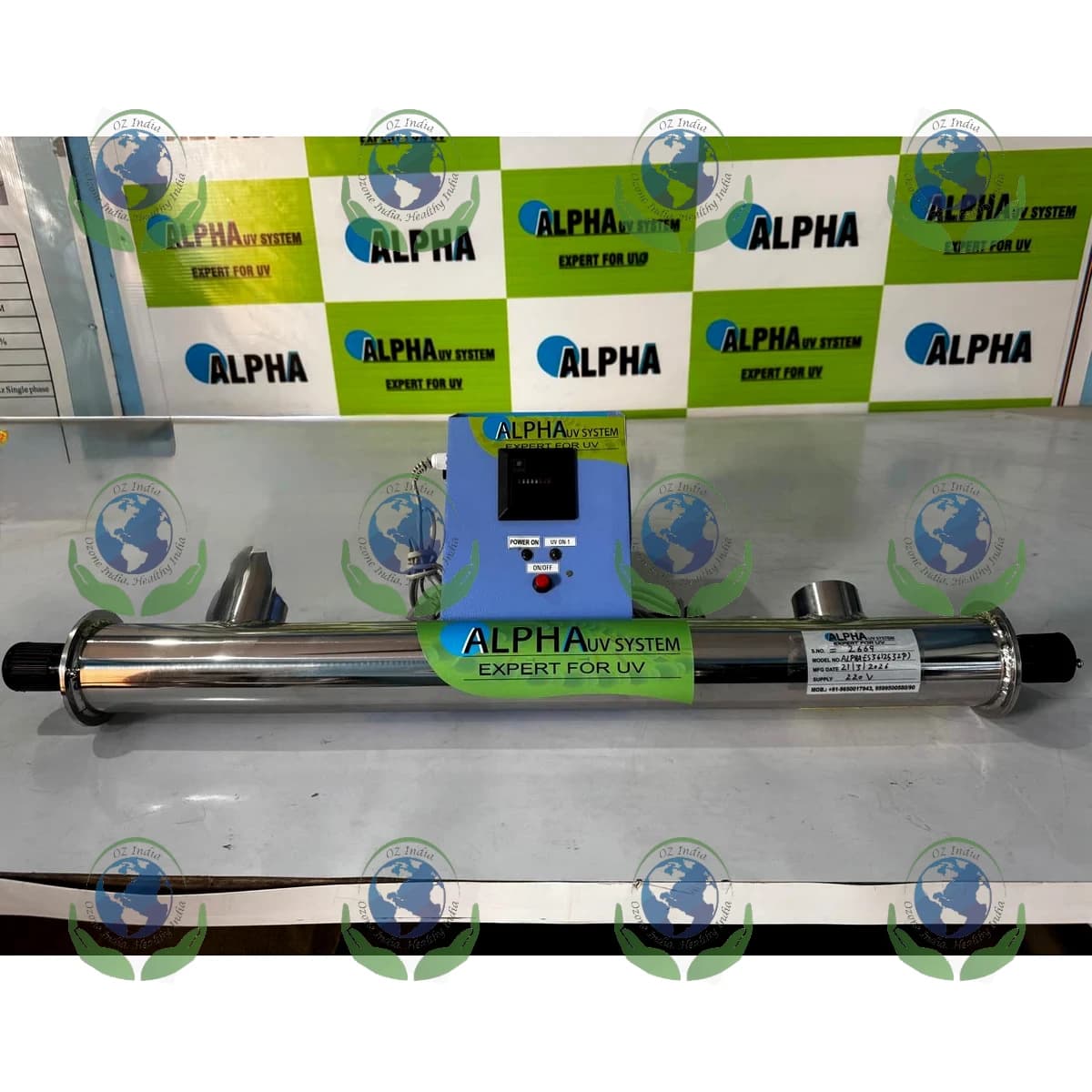
Compact Philips UV-C powered systems for household drinking water. Under-sink or inline installation. 6W power consumption — less than an LED bulb.
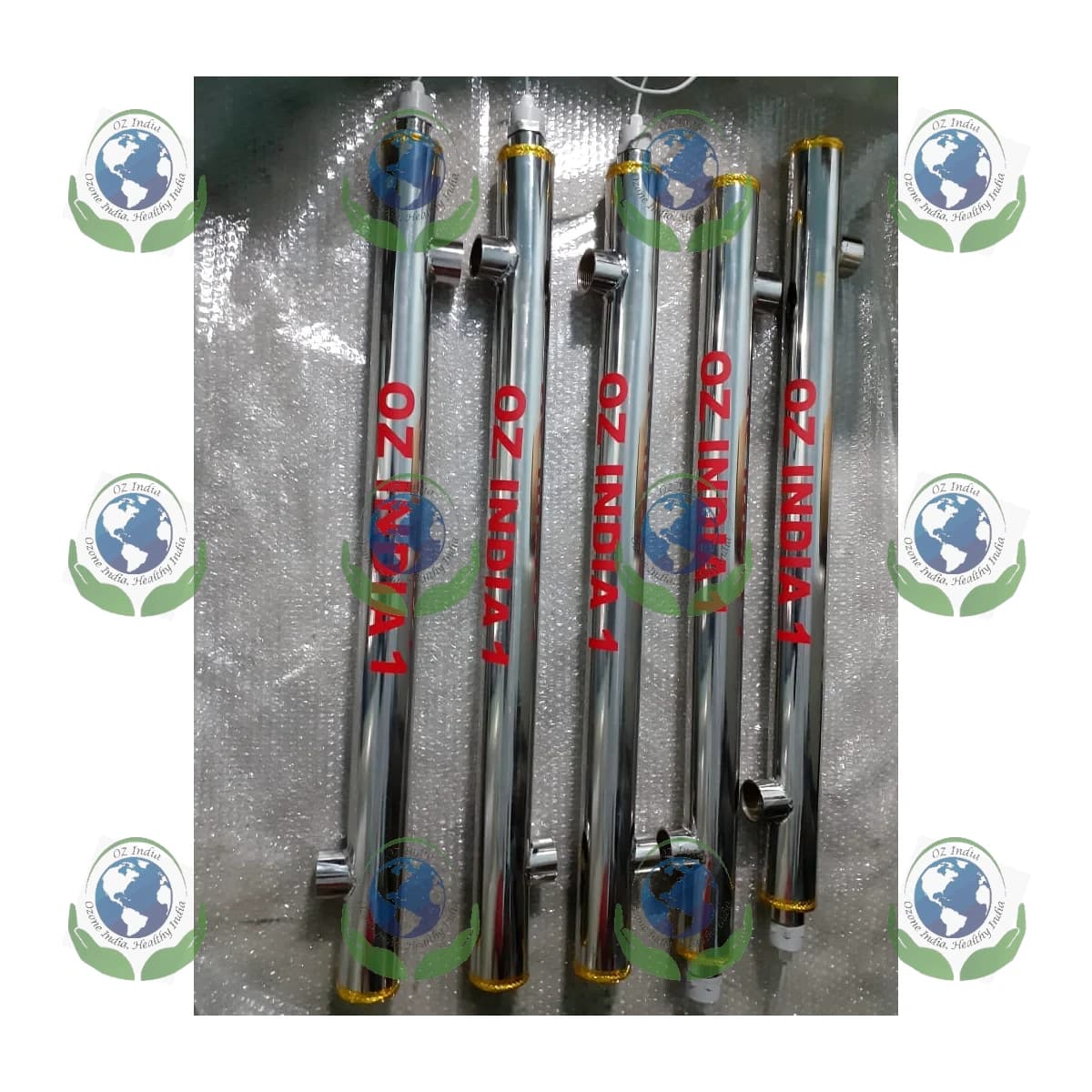
UV water disinfection for hotels, restaurants, offices, and educational institutions. HACCP and FSSAI compliant documentation. Trusted by Taj Hotels, McDonald's India, and IIT Kanpur.
IIT Patna Engineering
Alpha UV System IIT Patna engineers calculate UV dose from your actual water quality parameters — measured UVT, flow rate, target log reduction, and the specific compliance standard that governs your facility. Not from catalogue sizing tables or generic assumptions. Every system ships with a signed UV dose calculation report, a Philips certificate of authenticity, and compliance documentation prepared for the regulatory framework applicable to drinking water uv operations.
From measured UVT, flow rate, and target log-reduction. Signed by IIT Patna engineer.
WHO Guidelines 4th Ed. · BIS IS 10500:2012 · No Chemicals Added · 4-Log (99.99%) Pathogen Kill — documentation prepared to the audit checklist, not generic templates.
WhatsApp your flow rate, water quality, and compliance requirement — engineering-backed quote in 2 hours.
Mon–Sat · 9 AM–6 PM IST · IIT Patna alumni on call
Send us your flow rate and compliance requirement — quote with engineering rationale in 2 hours.
+91 93183 05878
Get Quote →
Call Direct
+91 95995 00580
Tap to Call →
Send Enquiry
Detailed specifications form
Open Form →
