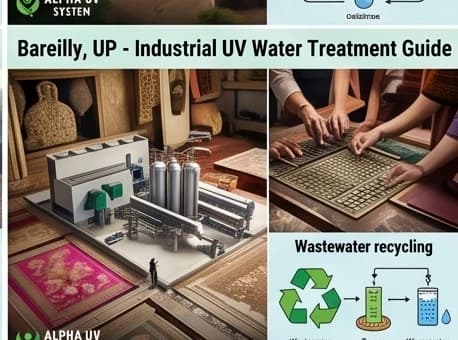
UV water treatment in Bareilly addresses four key needs: (1) post-overhead-tank disinfection for Bareilly's dense residential areas — BMC (Bareilly Municipal Corporation) supply from the Ramganga River loses residual chlorine in overhead tanks during western UP's summer heat (temperatures reach 44–46°C in May–June); (2) sugar mill and food processing UV — Bareilly division is one of UP's most productive sugarcane zones, with multiple sugar cooperatives and mills in Pilibhit, Shahjahanpur, and Bareilly districts requiring FSSAI food contact water; (3) zari and furniture industry UV — Bareilly is one of India's largest zari (metallic embroidery thread) production centres and a major furniture manufacturing hub, with industrial water safety requirements; and (4) UPPCB STP compliance under the NMCG Ramganga basin programme — the Ramganga is a Ganga tributary under NMCG monitoring. Alpha UV System supplies Philips UV-C lamp UV systems to Bareilly with 5–7 day delivery and UPPCB documentation support.
Bareilly — 250 km east of Delhi in the Rohilkhand region — is western UP's commercial and administrative hub, a city of historical significance (former capital of the princely state of Rohilkhand) and contemporary industrial importance. The city is simultaneously known for several distinct industries: zari (gold and silver metallic thread used in bridal and festival embroidery), which employs hundreds of thousands in the Bareilly-Rampur corridor; furniture manufacturing (particularly the Bareilly-brand rattan and bamboo furniture sold through UP Handloom Corporation); steel furniture (Bareilly has a significant steel almirah and furniture manufacturing cluster); and matches manufacturing (Bareilly's matches and fireworks sector has historical roots). The Ramganga River — flowing south from the Kumaon Himalayas through the Ramganga Barrage — provides Bareilly's water supply.
UV water treatment in Bareilly is necessitated by the combination of UP's characteristically hard summer (46°C with humid heat from the Tarai zone south of Bareilly) and the Ramganga's seasonal quality variation. The Ramganga in monsoon carries Kumaon sediment (turbidity NTU 100–500 during peak monsoon), and even in lean season receives Rampur-area textile effluent from the synthetic fabric dyeing units on the upper Ramganga. BMC's WTP treats this water, but post-storage contamination in Bareilly's overhead tanks remains the primary residential UV concern. Sugar mill FSSAI compliance, zari processing water, and UPPCB STP requirements under the NMCG Ramganga programme create the industrial UV demand that makes UV water treatment in Bareilly a commercially significant market for Alpha UV System.
Bareilly Water Quality by Zone and UV Requirement
| Zone / Area | Supply Type | Key Water Quality Issue | Recommended UV Solution |
|---|---|---|---|
| Central Bareilly (Civil Lines, Kutchery) | BMC piped supply (Ramganga River) | 45°C summer heat; Ramganga monsoon turbidity (July–Sept); supply intermittency; UPPCB STP enforcement | Post-tank UV at 40 mJ/cm²; 5 µm pre-filter; monthly monsoon pre-filter check; NMCG basin compliance |
| UPSIDC industrial area (Bareilly / Izatnagar) | UPSIDC supply + borewell | Pharmaceutical and chemical manufacturing; steel furniture; UPPCB STP compliance; borewell TDS 300–700 mg/L | Pharmaceutical UV (185+254 nm); Schedule M 2025; UPPCB STP UV; steel plant process UV |
| Zari embroidery industrial zone (Bareilly / Rampur) | Municipal supply + borewell | Zari wire drawing — FSSAI food contact (zari used in food decoration? No — industrial UV for worker potable and process water); export quality zari manufacturing | Worker potable UV; zari wire cooling water UV; UPPCB STP; Factories Act water standard |
| Pilibhit / Shahjahanpur (sugar mill zones) | Municipal supply + borewell + Ghaghra Canal | Sugar mills (cane crushing October–April); FSSAI food contact water for sugar processing; borewell iron 0.5–3 mg/L (Tarai zone) | Sugar mill process water UV; FSSAI compliance; borewell iron test before UV; UPPCB STP |
| New Bareilly residential (Cantt, Pilibhit bypass) | BMC supply + borewell | New residential growth; UPPCB STP mandatory ≥50 KLD; borewell iron check (Tarai alluvial zone) | Post-tank UV; STP UV; iron test borewell before UV; UPPCB documentation |
UV Water Treatment for Bareilly's Sugar Mills and Agri-Processing
The Bareilly-Pilibhit-Shahjahanpur sugar belt is one of Uttar Pradesh's most productive sugarcane zones, supporting multiple large cooperative sugar mills (Pilibhit cooperative sugar mill, Shahjahanpur mills) and private mills (Bajaj Hindusthan, Triveni Engineering plants in the broader region). Sugar mills use water at several critical points during the crushing season (October–April): sugarcane washing (removing soil and trash from harvested cane), juice extraction (water in the mill diffuser), juice clarification (lime and water), and vacuum pan crystallisation. FSSAI food safety standards require UV-treated water at all food contact applications in sugar processing.
UV water treatment in sugar mills addresses a specific microbial challenge: sugarcane juice — with its high sugar content (Brix 14–22%) — is an ideal growth medium for yeasts and bacteria. Any microbial contamination in the process water introduces organisms that ferment the juice, reducing sugar recovery and producing off-flavours in the final sugar. UV at 40 mJ/cm² on the process water prevents this contamination, improving sugar quality and yield. Sugar mills with FSSAI licenses (all food-grade sugar must be produced at FSSAI-licensed mills) need UV documentation as part of their FSSAI compliance package.
The Tarai zone's borewell iron challenge affects sugar mills in Pilibhit and Shahjahanpur: the Tarai's alluvial aquifer has elevated dissolved iron (0.5–3 mg/L common, occasionally 5+ mg/L). Iron in sugar process water causes problems beyond UV sleeve fouling — iron reacts with the tannins in sugarcane juice to produce dark-coloured iron-tannin complexes that affect sugar colour (ICUMSA colour value), reducing sugar market price. Iron removal before UV in Tarai zone sugar mills therefore addresses both UV system performance and sugar quality simultaneously.
UV System Sizing for Bareilly Applications
| Application | Flow Rate | UV Dose Required | Key Notes |
|---|---|---|---|
| Residential apartment (Bareilly city) | 1–3 m³/h | 40 mJ/cm² | Post-overhead-tank UV; 5 µm pre-filter; Ramganga monsoon turbidity — monthly pre-filter June–Sept |
| Sugar mill process water (Pilibhit / Shahjahanpur) | 5–30 m³/h | 40 mJ/cm² | FSSAI food contact; sugarcane juice contamination prevention; iron removal first if Fe >0.3 mg/L; seasonal Oct–Apr |
| Furniture / steel furniture worker potable (UPSIDC) | 1–3 m³/h | 40 mJ/cm² | Factories Act worker water; UPSIDC industrial township; Bareilly furniture sector large workforce |
| Pharmaceutical PW system (UPSIDC Bareilly) | 2–10 m³/h | 80 mJ/cm² | 185+254 nm; Schedule M 2025 IQ/OQ/PQ; UPPCB STP; CDSCO inspection file |
| Zari worker potable (Bareilly / Rampur) | 1–3 m³/h | 40 mJ/cm² | Large zari artisan workforce; Factories Act; borewell iron test mandatory in Rampur Tarai zone |
| Hospital potable (District Hospital / nursing homes) | 5–20 m³/h | 40–80 mJ/cm² | NABH documentation; ICU UV; dialysis AAMI/ISO 13959 |
| STP 300 KLD (Bareilly residential) | 20–30 m³/h | 40 mJ/cm² | Philips TUV 95W × 4; UPPCB consent; NMCG Ramganga basin; dual-lamp redundancy |
Recommended UV Systems for Bareilly — Philips UV-C Lamp Models
UV water treatment in Bareilly requires systems that handle UP's summer heat extremes, Ramganga's monsoon turbidity, and the specific requirements of the sugar and agri-processing sector. Alpha UV System's product range, using Philips UV-C lamps throughout, is appropriate for all Bareilly applications.
| Application / Segment | Recommended UV System | Philips Lamp Model | Flow Capacity | Key Advantage for Bareilly |
|---|---|---|---|---|
| Residential (individual flat) | Alpha UV 16W Domestic | Philips TUV 16W | Up to 1.5 m³/h | Compact; easy replacement; standard for UP residential UV |
| Small commercial / artisan workshop | Alpha UV 36W SS316L | Philips TUV 36W | Up to 3 m³/h | 316L SS body; worker potable; 50 KLD STP equivalent; UPPCB doc |
| Sugar mill process water | Alpha UV 55W SS316L | Philips TUV 55W | Up to 8 m³/h | FSSAI food contact; no chlorine; 316L SS food-grade; seasonal use (Oct–Apr) |
| Pharmaceutical PW system | Alpha UV 185+254nm Pharma | Philips TUV 36W (fused silica) | 2–5 m³/h | Dual-wavelength TOC + disinfection; IQ/OQ/PQ; Schedule M 2025 |
| STP 100–300 KLD / large industrial | Alpha UV 95W × 2–4 Industrial | Philips TUV 95W × 2–4 | 20–80 m³/h | UPPCB NMCG compliance; intensity monitoring; dual redundancy |
Regulatory Compliance Reference for Bareilly UV Systems
| Regulation / Authority | Applicable Sector | UV Requirement | Key Documentation |
|---|---|---|---|
| UPPCB STP Consent (Ramganga / NMCG basin) | Residential / commercial complexes ≥50 KLD | UV at 40 mJ/cm² on STP final effluent; faecal coliform <1,000 MPN/100 mL; NMCG online monitoring | UV commissioning report; intensity monitoring log; NMCG online monitoring connection |
| FSSAI (Sugar mills / food processing) | Pilibhit / Shahjahanpur sugar mills, food plants | IS 10500 food contact water; zero coliforms in 100 mL; UV maintenance records for FSSAI audit | FSSAI license UV annex; commissioning certificate; pre-filter log; NABL water test post-UV |
| CDSCO Schedule M 2025 (Pharmaceutical) | UPSIDC Bareilly pharmaceutical units | Purified Water UV; IQ/OQ/PQ validation; periodic requalification | UV IQ/OQ/PQ validation report; PW quality records; CDSCO file |
| UPPCB ETP Consent (industrial) | Zari / steel furniture / matches industrial ETP | ETP final effluent UV; coliform limits for Ramganga tributary discharge | UPPCB ETP consent conditions; UV commissioning; Ramganga basin discharge monitoring |
| Factories Act (Worker Water) | Zari, furniture, sugar mill workforces | Safe drinking water at all factory premises; UP Factory Inspector compliance | Factory license water safety compliance; UV system installed and operational |
Frequently Asked Questions — UV Water Treatment in Bareilly
Is the Ramganga River water suitable for UV treatment without RO in Bareilly?
For Bareilly's BMC piped supply (which is drawn from the Ramganga, treated at the WTP, and distributed through the city), UV without RO is generally appropriate. The treated Ramganga supply has TDS 300–500 mg/L in normal flow season — within the BIS acceptable range and well-suited for UV treatment with a 5 µm pre-filter. RO is not needed for standard Bareilly residential UV applications using BMC piped supply. However, during Ramganga monsoon floods (July–September), the raw river turbidity can challenge the WTP, and the treated supply may have elevated turbidity (above the UV system's 5 NTU tolerance at peak flood periods). During major monsoon turbidity events, check the pre-filter more frequently and verify UV intensity stays at rated level. For borewell water in the Tarai zone around Bareilly, iron testing is mandatory before UV — and if iron exceeds 0.3 mg/L, iron removal is required before UV.
Pilibhit sugar mills use Tarai borewell water — does iron affect sugar quality?
Yes — iron in Tarai borewell water (0.5–3 mg/L common in Pilibhit, Shahjahanpur, and Lakhimpur zones) affects sugar quality in two ways: (a) iron reacts with sugarcane's natural polyphenols (tannins) to form dark iron-tannin complexes that increase the ICUMSA colour value of the final sugar — white sugar with ICUMSA 45–100 is premium grade; iron-tannin contamination can increase ICUMSA to 300–500, downgrading the sugar and reducing its price by ₹2–5/kg; (b) iron deposits on the UV quartz sleeve make the UV system ineffective within weeks. For Pilibhit and Shahjahanpur sugar mills: (1) test borewell water iron before the crushing season; (2) install greensand iron removal filter if Fe >0.3 mg/L; (3) install UV after iron removal for microbiological safety. This treatment sequence improves both UV system reliability and sugar quality — making the investment worthwhile on both compliance and commercial grounds.
How strictly does UPPCB enforce STP compliance in Bareilly under the NMCG programme?
The Ramganga River is a significant Ganga tributary (joining the Ganga near Kannauj), and as such falls under NMCG (National Mission for Clean Ganga) monitoring. UPPCB's Bareilly district enforcement team has been active in issuing show-cause notices to residential complexes, hospitals, and commercial establishments for STP non-compliance and insufficient STP UV disinfection. The NMCG's online monitoring programme tracks real-time water quality at Ramganga monitoring stations — if Bareilly's STP discharges push coliform counts above the Ramganga monitoring threshold, UPPCB receives automatic alerts and triggers enforcement action. In 2023–24, multiple Bareilly residential complexes received closure notices for operating STPs without functioning UV systems. Alpha UV System's UPPCB STP documentation package (commissioning report, intensity monitoring log template, NMCG compliance documentation) is designed for Bareilly's NMCG-governed enforcement environment.
Why do Bareilly's zari embroidery workers need UV-treated water?
Bareilly's zari (metallic embroidery thread — typically gold-coloured copper core wrapped with polyester or silk threads used in bridal sarees, lehengas, and festival wear) manufacturing employs hundreds of thousands of artisans in home-based and workshop settings. The Factories Act (applicable to establishments with 10+ workers) requires the employer to provide safe drinking water at all factory premises. Many zari workshops draw borewell water for worker drinking and process cooling. In the Rampur-Bareilly corridor's Tarai zone, borewell water often has iron 1–3 mg/L and TDS 400–700 mg/L — water that is palatable for drinking but can cause reddish staining and has high microbial risk if stored in unprotected containers. UV at 40 mJ/cm² (after iron removal if needed) provides safe drinking water for the large artisan workforce in compliance with the Factories Act and the UP Factory Inspector's requirements.
Alpha UV System supplies UV disinfection systems to sugar mills, zari manufacturers, pharmaceutical units, residential complexes, hospitals, and STP operators across Bareilly, Pilibhit, Shahjahanpur, Izatnagar, Rampur, and the Ramganga-Ganga basin. UPPCB/NMCG STP documentation. FSSAI sugar mill food safety UV. Schedule M 2025 pharma UV. Philips UV-C lamps. 5–7 day delivery to Bareilly.
WhatsApp Us for Bareilly UV System SupplyStandards, authorities & further reading
External references used to inform this guide. Regulations evolve — check the latest revision on each authority's site before compliance decisions.
Recommended UV Systems
Alpha UV System products for this application — powered by genuine Philips UV-C lamps.
Commercial UV Water Purification System
500 – 5,000 LPH
HACCP-compliant UV water purification for hotels, restaurants, and offices
Industrial UV Water Treatment System
5,000 – 50,000 LPH
Schedule M 2025 and HACCP compliant UV for pharma, food & beverage, and process water
Not sure which system suits your application? WhatsApp our engineers for a free recommendation →
Related solutions
See how Alpha UV System applies this to your industry or city.
Need a UV system?
Talk to our UV engineers — WhatsApp for a quote in 2 hours, or browse the full catalog on IndiaMART.