Manufactured in Greater NoidaGenuine Philips UV-C LampsIIT Patna Alumni on Our TeamExporting to 20+ Countries
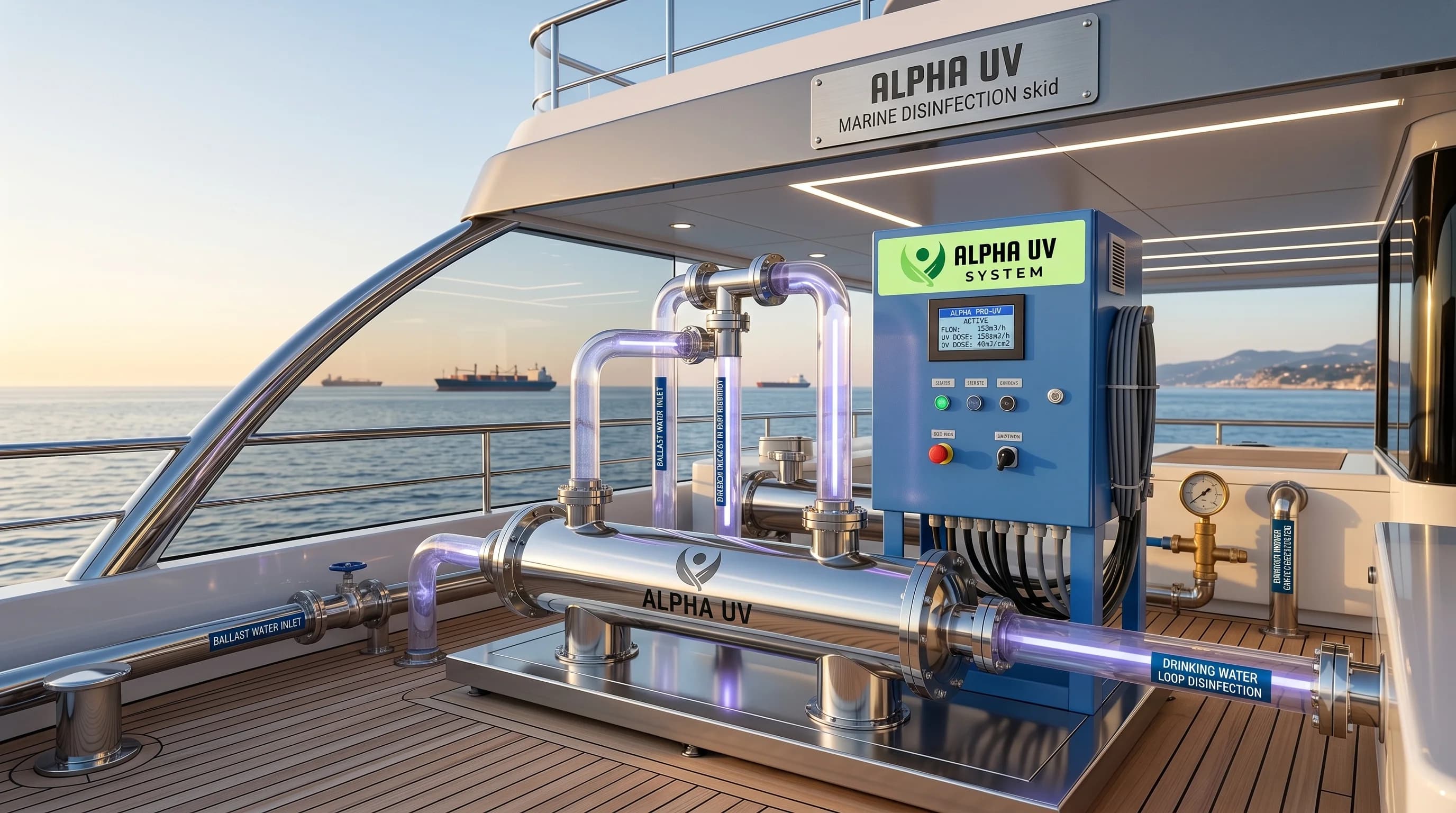
The marine industry faces a dual disinfection imperative: preventing the global spread of invasive aquatic species via ballast water discharge, and ensuring safe potable water for crews operating thousands of kilometres from shore. Ballast water — taken on by commercial vessels to maintain stability when cargo is unloaded and discharged at the loading port — carries living organisms from source to destination ecosystems across oceans. The IMO Ballast Water Management Convention (BWM Convention, in force 2017) mandates that all vessels above 400 GT treat ballast water to D-2 performance standards before discharge: fewer than 10 viable organisms per cubic metre for organisms ≥50 µm, and fewer than 10 viable organisms per millilitre for organisms 10–50 µm. UV disinfection — combined with mechanical filtration — is one of the two dominant type-approved treatment technologies meeting IMO D-2 globally. Alpha UV System's high-intensity UV chambers for ballast water treatment are rated for the wide flow and water clarity range encountered in ocean and coastal operations, from clear open-sea water to turbid estuarine water at UV transmittance as low as 42%.
UV Dose
40–400 mJ/cm²
Capacity
50,000 – 50,00,000 LPH
Commercial shipping moves over 10 billion tonnes of cargo per year, and with it carries an estimated 7,000–10,000 species of marine organisms in ballast water every day. When a vessel takes on ballast water to compensate for discharged cargo weight, it draws in millions of litres of seawater from the local marine ecosystem — including plankton, bacteria, viruses, invertebrate larvae, and fish eggs at concentrations that can reach 10,000 organisms per cubic metre for large phytoplankton and zooplankton species. When that same vessel discharges its ballast at a distant port, it releases all those organisms into a foreign marine ecosystem.
The consequences of invasive species introduction via ballast water are well documented. The comb jellyfish Mnemiopsis leidyi, introduced to the Black Sea in the 1980s via US vessel ballast water, caused the collapse of the anchovy fishery worth over USD 350 million annually. The Golden Mussel (Limnoperna fortunei) reached South America in ballast water from Asia and now dominates freshwater ecosystems in the La Plata basin. Indian coastal waters — biologically diverse and ecologically sensitive — face the same threat from inbound vessels carrying organisms from non-native ecosystems.
The IMO Ballast Water Management Convention (BWM Convention), adopted in 2004 and entering into force in September 2017, was negotiated specifically to address this threat. Regulation D-2 of the Convention sets the performance standard for treated ballast water — a standard that cannot be met by ballast water exchange (the previous practice of replacing coastal water with open-ocean water) but can be met by UV filtration systems. UV treatment is one of two principal type-approved technologies (alongside electrochlorination) meeting D-2 globally.
Regulation D-2 defines performance standards across three organism size classes and three bacterial indicator parameters. For organisms 50 µm or larger in minimum dimension, the discharge limit is fewer than 10 viable organisms per cubic metre of ballast water. For organisms 10–50 µm in minimum dimension, the limit is fewer than 10 viable organisms per millilitre. Indicator bacteria limits are: total coliforms below 250 CFU/100 mL, faecal coliforms (E. coli) below 100 CFU/100 mL, and toxicogenic Vibrio cholerae O1 and O139 not detected in 100 mL.
UV-based BWTS meets these standards through a two-stage process. Automatic self-cleaning disc filters (typically 40–50 µm mesh size, MEPC.174(58)-certified) remove organisms in the ≥50 µm size class by physical filtration — meeting the D-2 ≥50 µm limit through removal rather than inactivation. High-intensity UV chambers then inactivate organisms in the 10–50 µm size class and the bacterial indicators in the filtered water. The UV dose required depends critically on the UV transmittance (UVT) of the water, which varies from 90% in clear open-ocean water to as low as 42% in the challenging coastal and estuarine waters used as the worst-case condition in the MEPC.174(58) type-approval test.
The relationship between UVT, flow rate, and effective UV dose is the central engineering challenge in ballast water UV system design. UV photons are absorbed by dissolved organic matter and particles in the water before they can reach and inactivate organisms. In clear open-sea water (UVT ≥85%), a UV system can treat large volumes at a relatively modest lamp power. In turbid coastal water (UVT 50–60%), the same lamp bank must treat much smaller volumes to deliver sufficient dose to the organisms within the shorter photon path length remaining after absorption.
Type-approved UV BWTS configurations are therefore characterised by their rated capacity at the worst-case (lowest) UVT tested during MEPC.174(58) type-approval, not their capacity at clear water conditions. A system rated for 200 m³/hour at UVT 42% will treat substantially larger volumes (400–600 m³/hour) in the clearer water conditions that characterise most deep-sea voyages. Vessels trading primarily in open-ocean routes with infrequent port calls in turbid coastal waters can take advantage of this variability by operating the UV system at reduced power output when UVT is high and ramping up lamp output when coastal port conditions reduce UVT.
The only commercially significant alternative to UV filtration for ballast water treatment is electrochlorination, which generates sodium hypochlorite in situ from seawater to kill organisms chemically. While electrochlorination is an effective and type-approved technology, it generates Total Residual Oxidants (TRO) in the treated ballast water that must be monitored and, in some regulatory frameworks, neutralised before discharge to prevent toxicity to receiving marine organisms.
UV treatment generates no chemical residuals in the treated water. The UV-treated ballast water is discharged with zero chemical additives — it is simply water from which living organisms have been inactivated by photon energy. This chemical-free characteristic is increasingly valued by port state authorities concerned about discharge toxicity, and has no risk of creating toxic byproducts from reactions between residual active substance and organic matter in the discharge water. GESAMP (Group of Experts on the Scientific Aspects of Marine Environmental Protection), which evaluates active substance risk for the IMO BWM Convention, does not apply to UV-based BWTS because UV is not classified as an active substance — simplifying the regulatory approval pathway compared to chemical-based alternatives.
Commercial vessels have widely varying ballasting rates depending on cargo operations. A large bulk carrier may need to take on or discharge 20,000–50,000 m³ of ballast water within 8–12 hours of a port call. A container vessel may complete ballast operations in 4–6 hours. The BWTS must handle the peak ballasting rate of the vessel, not an average rate.
Alpha UV System UV BWTS configurations for large vessels use parallel multi-chamber UV arrays where individual chambers can be switched in or out depending on the instantaneous ballasting flow rate. At low flow rates (harbour manoeuvring with minimal ballast change), fewer chambers are activated. At peak ballasting rate, all chambers operate simultaneously at full lamp power. This modular approach allows the UV system to maintain the required UV dose per unit volume across the full range of operational flow rates without over-treating at low flow rates (which would reduce lamp life) or under-treating at peak flow rates.
The economic case for UV-based BWTS compared to chemical alternatives is compelling over the operational life of a vessel. UV lamps have a service life of 8,000–12,000 hours and represent the primary consumable cost in a UV BWTS. Chemical systems require continuous supply of active substances — typically sodium hypochlorite (electrochlorination) or proprietary chemicals — whose cost accumulates continuously throughout vessel operations.
For a 50,000 DWT bulk carrier, IMO BWM compliance retrofit with a UV BWTS requires a capital investment that is recovered through lower operating costs within 4–6 years relative to chemical treatment alternatives. Over the full 25-year economic life of a vessel, the accumulated savings favour UV BWTS by a substantial margin. For Indian shipping companies managing fleets of bulk carriers, tankers, and general cargo vessels, Alpha UV System provides fleet-level UV BWTS proposals with volume pricing for simultaneous multi-vessel retrofits. IIT Patna-trained engineers provide the technical compliance documentation required for DG Shipping submission alongside each supply.
Contact Alpha UV System at WhatsApp 9318305878 for a ballast water UV BWTS proposal tailored to your vessel class, flag state, trading routes, and ballasting rate requirements. Our team responds within 24–48 hours with a technically complete specification including IMO type-approval documentation and fleet pricing.
Recommended Products
IIT Patna engineers recommend these systems for marine uv applications based on flow rate, required UV dose, and compliance standard. Both systems use genuine Philips UV-C lamps and ship with complete compliance documentation.
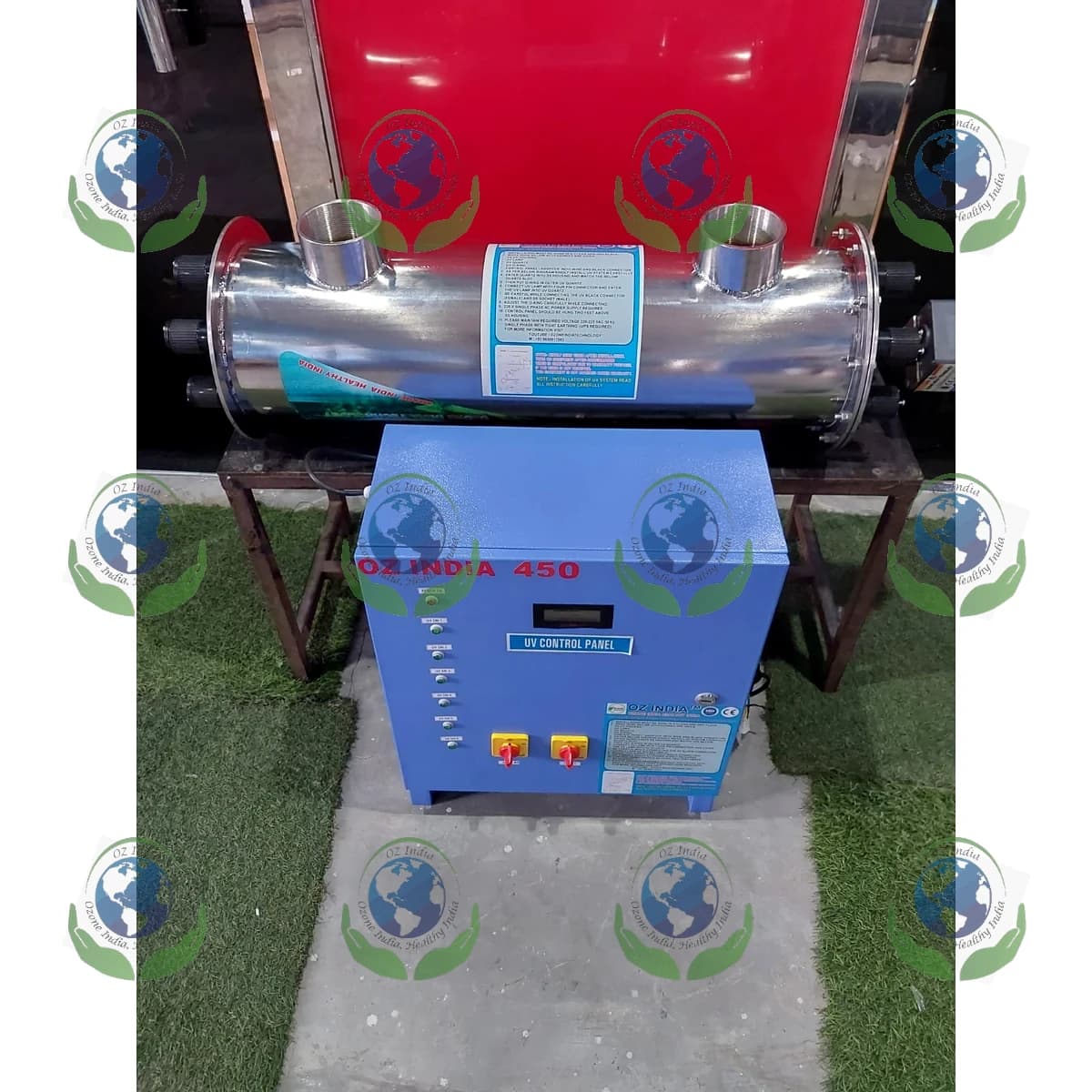
High-flow UV water treatment for pharmaceutical WFI, food & beverage process water, and industrial applications. Revised Schedule M 2025, HACCP, and FSSAI compliant. IQ/OQ/PQ documentation.
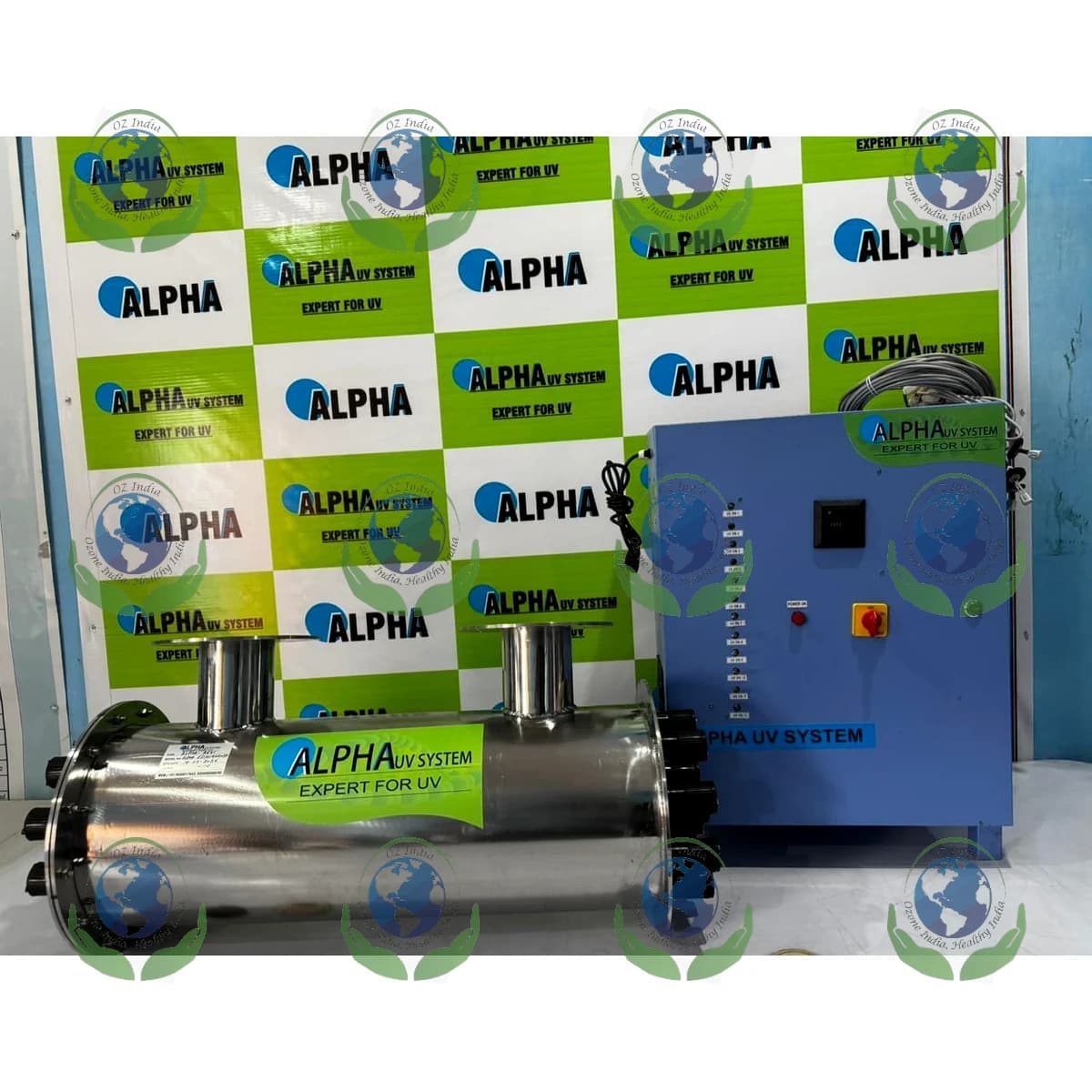
High-capacity UV disinfection for municipal water supply. BIS IS 10500:2012 and CPCB compliant. Open-channel and closed-vessel. PLC/SCADA control. MSME registered for government procurement.
IIT Patna Engineering
Alpha UV System IIT Patna engineers calculate UV dose from your actual water quality parameters — measured UVT, flow rate, target log reduction, and the specific compliance standard that governs your facility. Not from catalogue sizing tables or generic assumptions. Every system ships with a signed UV dose calculation report, a Philips certificate of authenticity, and compliance documentation prepared for the regulatory framework applicable to marine uv operations.
From measured UVT, flow rate, and target log-reduction. Signed by IIT Patna engineer.
IMO BWM Convention D-2 · USCG Ballast Water Rule · MARPOL Annex IV · ISO 8217 — documentation prepared to the audit checklist, not generic templates.
WhatsApp your flow rate, water quality, and compliance requirement — engineering-backed quote in 2 hours.
Mon–Sat · 9 AM–6 PM IST · IIT Patna alumni on call
Send us your flow rate and compliance requirement — quote with engineering rationale in 2 hours.
+91 93183 05878
Get Quote →
Call Direct
+91 95995 00580
Tap to Call →
Send Enquiry
Detailed specifications form
Open Form →
