Manufactured in Greater NoidaGenuine Philips UV-C LampsIIT Patna Alumni on Our TeamExporting to 20+ Countries
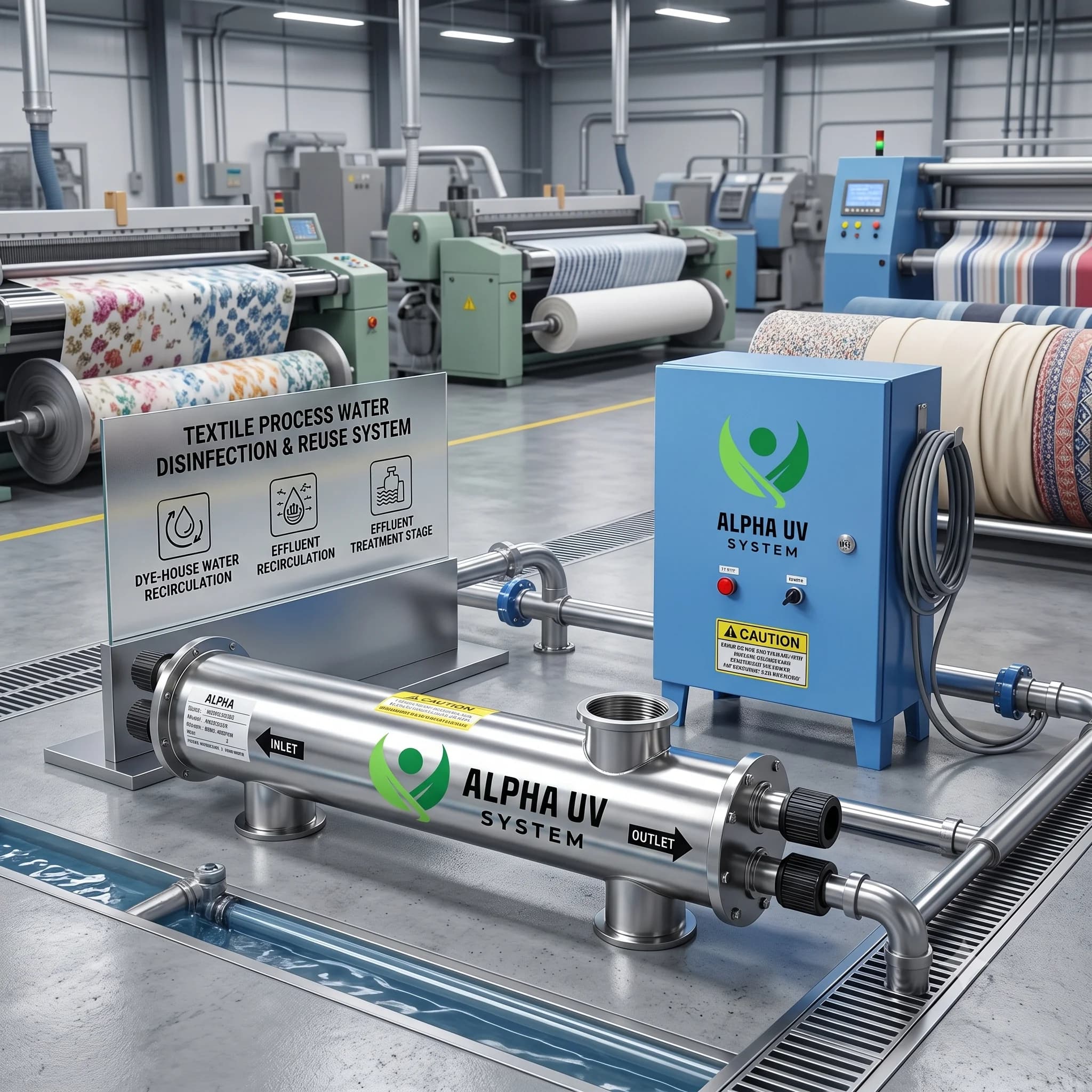
Textile processing wastewater carries heavy dye loads, high COD, and microbial contamination from natural fibre processing that challenge conventional disinfection. Alpha UV Systems delivers UV-C disinfection for textile ETP tertiary treatment that achieves CPCB discharge compliance and ZLD support without chlorine-based disinfection by-products — protecting receiving water bodies and enabling treated water reuse.
UV Dose
40–100 mJ/cm²
Capacity
10,000 – 5,00,000 LPH
India's textile and dyeing industry operates under increasingly stringent environmental regulations that directly shape water treatment requirements at every facility level. The Central Pollution Control Board (CPCB), acting under the Environment Protection Act 1986, sets General Standards for Discharge of Environmental Pollutants in Schedule VI — standards that apply to all textile processing units discharging to inland surface water, public sewers, or land.
The CPCB Zero Liquid Discharge (ZLD) notification of 2016 marked a watershed in textile sector environmental compliance. Textile processing units in 17 critically polluted industrial clusters across India — including Tirupur, Surat, Ludhiana, and Panipat — are required to achieve ZLD, meaning all process water must be treated and recycled with zero effluent discharge to the environment. This requirement fundamentally changes the role of water treatment from discharge compliance to water reclamation, placing microbial disinfection at the centre of the ZLD treatment train.
The National Green Tribunal (NGT) has reinforced these requirements with multiple orders directing state pollution control boards to enforce ETP compliance in textile clusters, including specific mandates for tertiary treatment of textile effluent before discharge or reuse. Microbial compliance — particularly for total coliforms, fecal coliforms, and BOD — is routinely flagged in CPCB compliance inspections as the parameter most frequently failing in textile ETPs that rely on secondary biological treatment alone.
Alpha UV Systems provides UV-C disinfection as the tertiary treatment step that closes this compliance gap. Our systems deliver validated microbial inactivation at the UV dose required for CPCB discharge compliance while adding no chemical residuals that could create AOX violations or additional discharge parameter failures.
The compliance data above — based on CPCB Schedule VI discharge standards and treatment efficacy data from UNEP textile guidelines — demonstrates that secondary biological treatment alone typically leaves total coliform counts of 800 MPN/100 mL, far above CPCB limits. UV treatment at 60 mJ/cm² achieves 12 MPN/100 mL — compliant for discharge. UV at 100 mJ/cm² achieves non-detect — compliant for ZLD water reuse in process applications.
The most critical technical challenge in applying UV disinfection to textile ETP effluent is the low UV transmittance (UVT) characteristic of dye-bearing wastewater. UVT is a measure of how much 254 nm UV-C light passes through the water — higher UVT means more UV-C energy reaches the microorganisms, enabling efficient disinfection at reasonable lamp power.
Textile effluent — particularly from reactive dye and direct dye processes — contains chromophoric compounds that absorb strongly at 254 nm. After standard biological treatment, reactive dye effluent typically shows UVT of 20–40%. At this UVT, a standard UV system sized for 40 mJ/cm² in clear water would deliver only 8–16 mJ/cm² at the design flow rate — insufficient for CPCB compliance.
The solution is not simply to add more UV lamps (though some dose enhancement is possible), but to ensure adequate pre-treatment before the UV stage. The UVT improvement through successive treatment steps is predictable:
Alpha UV Systems designs every textile ETP installation after site-specific UVT measurement at the proposed UV installation point. We will not supply a UV system to a location with insufficient UVT — instead, we advise on pre-treatment options that will bring UVT to the required level and ensure the UV system delivers the specified dose.
The UVT improvement curve above, based on Textile Research Journal data and CPCB ZLD treatment train performance, confirms that UV disinfection should be positioned after activated carbon filtration or membrane treatment in the textile ETP process train for reliable performance. Alpha UV Systems provides complete treatment train advisory services for textile sector clients.
Beyond ETP effluent treatment, UV disinfection has valuable applications throughout the textile production process for incoming water treatment and process water quality management. Natural fibre processing — particularly cotton scouring, jute processing, and wool washing — involves high organic loads and warm temperatures that create ideal conditions for microbial contamination of process water.
Scouring Water: Cotton scouring removes natural waxes, fats, and other surface contaminants using hot alkaline water (80–95°C). The organic load in spent scouring water exceeds 10,000 mg/L BOD. If untreated scouring water recontaminates fresh water supply through cross-connections or incomplete separation, it introduces both organic load and high bioburden (up to 5.8 log CFU/mL) to subsequent process stages.
Dyeing Bath Water: Dyeing baths operate at 60–95°C but cool during loading and unloading. Residual dyestuffs, surfactants, and organic matter in dye bath water support significant microbial growth. Microbial contamination of dyeing baths causes inconsistent colour uptake, spots, and shade variation — all of which are quality defects that translate directly to fabric rejection costs.
Finishing and Softening Water: Textile finishing operations — softening, resin treatment, flame retardant application — use water containing various finishing chemicals at lower temperatures (40–60°C). These conditions support rapid microbial growth. High bioburden in finishing water causes fabric yellowing, malodour, and compromised finishing uniformity.
UV treatment of incoming process water at each stage prevents contamination at the source rather than attempting to remediate contaminated process baths. Alpha UV Systems designs inlet UV treatment for all major process water streams in textile plants, with system sizing based on the specific flow demand and water quality of each stream.
The bioburden data above, from UNEP Environmental Management for the Textile Industry (2001) and Textile Research Journal contamination studies, highlights the high microbial loading in finishing and softening water — often overlooked in favour of scouring and dyeing treatment. Alpha UV Systems' IIT Patna-trained engineers assess all process water streams during site visits to identify the full scope of UV treatment requirements.
The traditional disinfection approach for textile ETP effluent — chlorination using sodium hypochlorite or chlorine gas — creates a serious secondary compliance problem: formation of absorbable organic halides (AOX).
When chlorine reacts with the complex organic compounds in textile effluent — reactive dye molecules, dispersing agents, levelling agents, and textile processing auxiliaries — it forms chlorinated organic compounds collectively measured as AOX. CPCB General Standards for Discharge (Schedule VI) set a maximum AOX limit of 1 mg/L for inland surface water discharge. Chlorination of even partially-treated textile effluent routinely produces AOX concentrations of 5–20 mg/L — creating an AOX violation while attempting to achieve a microbial compliance improvement.
The chlorine dose required for reliable microbial inactivation in textile effluent (typically 10–30 mg/L free chlorine due to high chlorine demand of textile chemicals) dramatically amplifies AOX formation. Dechlorination to remove excess chlorine before discharge is then necessary — adding cost and complexity without eliminating already-formed AOX.
UV disinfection has no reaction chemistry with dissolved organic compounds. UV-C photons damage microbial DNA but do not react with dye molecules, dispersing agents, or other textile process chemicals at the wavelengths and doses used for disinfection. The result is reliable microbial inactivation with no AOX formation, no additional colour impact, and no secondary compliance problems.
The colour and AOX comparison above, from Textile Research Journal (Sage, 2021) and CPCB compliance audit data, confirms that UV disinfection achieves ADMI colour compliance for CPCB discharge (≤400 ADMI for inland surface water) while chlorination at effective doses actually worsens colour compliance and creates AOX violations. UV is the only viable disinfection option for textile ETP discharge compliance where colour and AOX limits must simultaneously be met.
CPCB discharge compliance for textile ETPs requires simultaneous compliance with multiple parameters. UV disinfection contributes directly to microbial compliance and indirectly supports colour compliance. Understanding the scope of UV's role within the complete ETP compliance picture is important for plant managers planning treatment upgrades.
Parameters directly improved by UV:
Parameters not affected by UV (require separate treatment):
Parameters indirectly supported by UV:
The compliance achievement data above demonstrates that adding UV as the final step in a textile ETP brings total coliform compliance from 42% (secondary treatment only) to 99%, closing the most common compliance gap while maintaining the BOD and TSS compliance already achieved by biological treatment.
For a 1 MLD (1,000 m³/day) textile ETP, the annual operating cost comparison demonstrates that UV disinfection costs approximately INR 4.5 lakhs per year — lamp replacement and power only. Sodium hypochlorite dosing at equivalent disinfection efficacy (accounting for high chlorine demand in textile effluent) costs INR 18.5 lakhs per year in chemical costs alone, before additional costs for AOX exceedance penalties and dechlorination chemicals. Chlorine gas, while lower unit cost, creates higher handling safety costs and still generates AOX.
The capital investment differential is also favourable: Alpha UV Systems UV units for 1 MLD flow have lower capex than the chemical dosing, storage, and dechlorination infrastructure required for reliable chlorination of textile effluent.
Alpha UV Systems has installed UV disinfection systems in textile ETPs and ZLD plants across India's major textile clusters. Our systems are designed by IIT Patna-trained engineers who understand both the UV technology and the CPCB compliance requirements specific to the textile sector.
Our service to textile clients includes pre-installation UVT measurement at your ETP discharge point, UV system design validated against your specific water quality and flow rate, commissioning with UV dose verification, and CPCB compliance documentation for your ETP consent to operate file.
WhatsApp: 9318305878 — 24–48 hour response guaranteed.
Achieve CPCB discharge compliance. Enable ZLD water reuse. Eliminate AOX risk from chlorination — with UV disinfection engineered for India's textile industry.
Recommended Products
IIT Patna engineers recommend these systems for textile uv applications based on flow rate, required UV dose, and compliance standard. Both systems use genuine Philips UV-C lamps and ship with complete compliance documentation.
IIT Patna Engineering
Alpha UV System IIT Patna engineers calculate UV dose from your actual water quality parameters — measured UVT, flow rate, target log reduction, and the specific compliance standard that governs your facility. Not from catalogue sizing tables or generic assumptions. Every system ships with a signed UV dose calculation report, a Philips certificate of authenticity, and compliance documentation prepared for the regulatory framework applicable to textile uv operations.
From measured UVT, flow rate, and target log-reduction. Signed by IIT Patna engineer.
CPCB ETP Discharge Norms (Schedule VI) · IS 10500:2012 · ISO 14001 Environmental Management · ZLD (Zero Liquid Discharge) Requirements — documentation prepared to the audit checklist, not generic templates.
WhatsApp your flow rate, water quality, and compliance requirement — engineering-backed quote in 2 hours.
Mon–Sat · 9 AM–6 PM IST · IIT Patna alumni on call
Send us your flow rate and compliance requirement — quote with engineering rationale in 2 hours.
+91 93183 05878
Get Quote →
Call Direct
+91 95995 00580
Tap to Call →
Send Enquiry
Detailed specifications form
Open Form →