Manufactured in Greater NoidaGenuine Philips UV-C LampsIIT Patna Alumni on Our TeamExporting to 20+ Countries
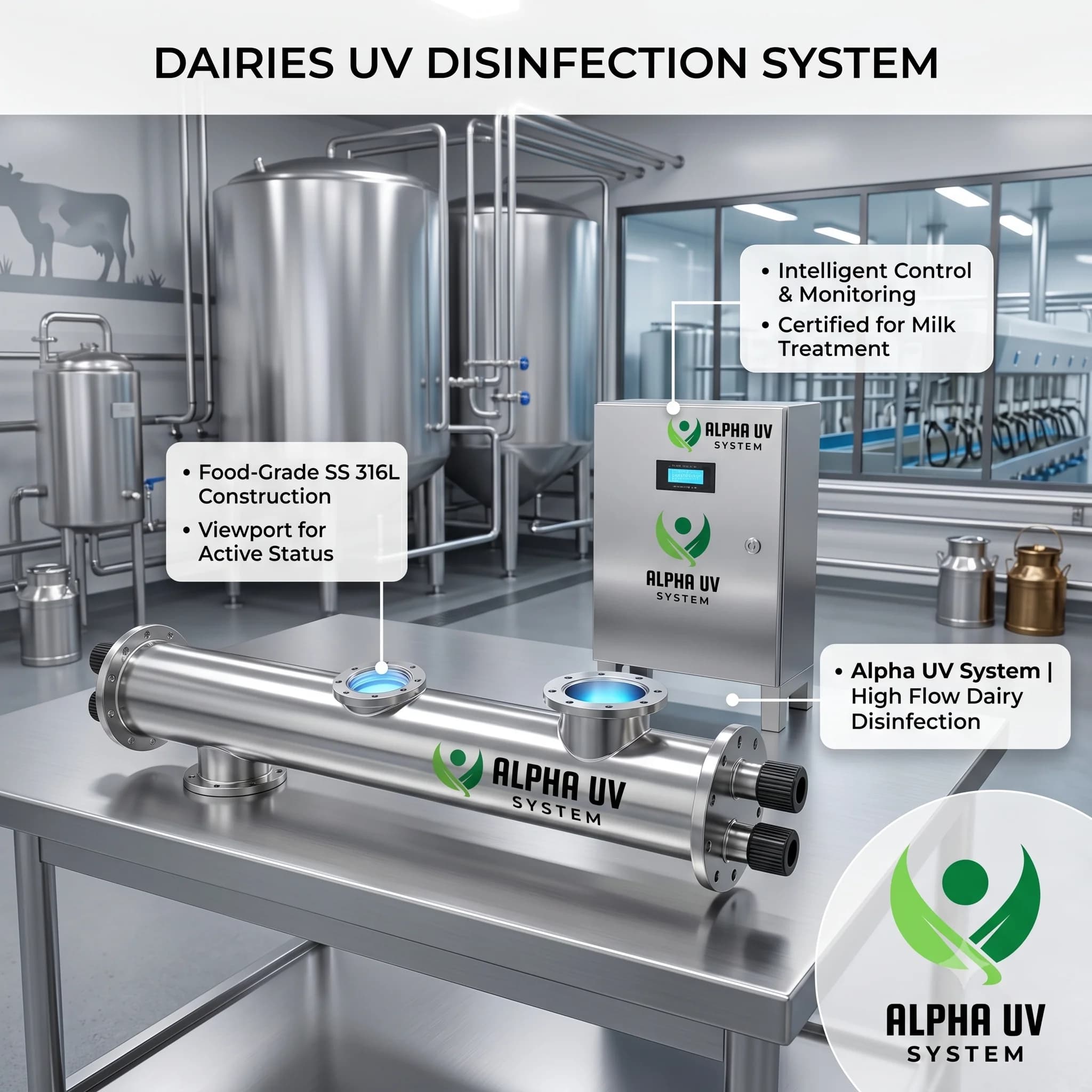
Dairy process water quality directly affects milk safety, product shelf life, and FSSAI regulatory compliance. Chlorination of dairy process water introduces the risk of chlorine taste-taint in milk and dairy products — an unacceptable quality failure in any dairy operation. UV disinfection at 40–80 mJ/cm² controls Listeria monocytogenes, coliform bacteria, Salmonella, and dairy-specific pathogens in process water and CIP rinse water without any chemical addition, preserving milk organoleptic quality while meeting FSSAI dairy regulations, IS 1479 dairy water standards, and Codex Alimentarius STAN 193. Alpha UV System: food-grade SS316L construction, Philips UV-C, IIT Patna-trained engineers.
UV Dose
40–80 mJ/cm²
Capacity
1,000 – 1,00,000 LPH
Dairy manufacturing has more demanding water quality requirements than most other food industries because water contacts milk and dairy products directly, and any contaminant in the water appears in the finished product. Water is used as an ingredient in reconstituted dairy products, an ingredient in dairy formulations, the medium for pasteurisation heat exchange, the rinse water for milk tanks and pipelines in CIP systems, and the cleaning agent for packaging lines. Each of these contact points represents a potential contamination route from water to dairy product.
FSSAI Food Safety and Standards Regulations 2011 mandate that water used in dairy manufacturing must meet IS 10500:2012 drinking-water quality standards at every point of use. IS 1479 (Methods of Test for Dairy Industry) specifies the water quality parameters that dairy inspectors test during FSSAI dairy plant audits. The Codex Alimentarius General Standard for Contaminants and Toxins in Food and Feed (STAN 193-1995, amended 2022) provides the international framework for contaminant limits in dairy products that FSSAI's dairy standards are aligned with.
The International Dairy Federation (IDF) Document 478: Hygienic Design of Dairy Plants (2018) is the most comprehensive technical reference for dairy plant water systems. IDF 478 specifically addresses water treatment, CIP water quality, and the hygiene engineering requirements for water contact equipment in dairy manufacturing — and UV disinfection is identified as the preferred treatment technology for CIP final rinse water in dairy applications globally.
Listeria monocytogenes is the pathogen of greatest concern for dairy manufacturers. Unlike Salmonella and E. coli O157:H7, which are primarily heat-sensitive and controlled by pasteurisation, Listeria grows at refrigeration temperatures (2–4°C) and can contaminate ready-to-eat dairy products (paneer, soft cheese, yogurt, cream, flavoured dairy beverages) at any point after pasteurisation — including through contaminated process water, CIP rinse water, or packaging rinse water.
Listeria outbreaks in dairy products have caused some of the most serious global food safety incidents of the past three decades. In India, FSSAI recall data shows soft fresh dairy products (paneer, dahi, mishti doi) as among the most frequently recalled categories for microbial contamination. Water is a documented Listeria transmission route in dairy environments — particularly from condensate drains, floor wash water splashing onto product-contact surfaces, and CIP rinse water from improperly maintained water treatment systems.
UV disinfection at 40 mJ/cm² delivers 7-fold safety margin above the 5.5 mJ/cm² dose needed for 4-log Listeria inactivation. Alpha UV System dairy UV systems are designed to maintain this dose continuously, 24 hours a day, across all process water supply points in the dairy — from main supply to CIP rinse to pasteurisation jacket water.
Clean-in-Place (CIP) systems are the standard method for cleaning dairy processing equipment — milk silos, pasteurisers, separators, filling machines, and packaging lines — without disassembly. A standard dairy CIP cycle consists of: pre-rinse (remove milk residue), caustic wash (NaOH 1.5–2%, 72–85°C, remove protein and fat), intermediate rinse (remove caustic), acid wash (HNO₃ or citric acid 0.5–1.5%, 65–70°C, remove mineral scale), and final rinse (water flush to remove all chemicals).
The final rinse water is the last water that contacts the dairy equipment surface before milk or dairy product is introduced. If the final rinse water contains: (a) residual chlorine from chlorinated rinse water — it creates taste-taint risk; (b) microbiological contamination — it re-inoculates the cleaned surface; (c) residual cleaning chemical — it contaminates the product. UV treatment of CIP final rinse water addresses concern (b) completely — the UV-treated water is microbiologically clean and chemically neutral, presenting no taste-taint risk and no microbial contamination of the freshly cleaned equipment surface.
IDF Document 478 Section 6.2 specifies CIP rinse water quality requirements: microbiological quality equivalent to potable water, with particular emphasis on absence of coliforms and Listeria. Alpha UV System dairy UV systems for CIP rinse applications are rated for the peak CIP rinse flow rate — typically 2,000–10,000 LPH — and are designed with CIP bypass valve so that the UV chamber is isolated during the caustic and acid CIP phases and energised only during the final rinse phase.
Fresh dairy product manufacturing — paneer, chhena, soft cheese, yogurt, dahi, mishti doi, rabri — uses water directly in the product formulation and as the processing medium. Paneer production uses water for milk heating, curd washing, and mould pressing; soft cheese production uses brine (water + salt) for curing; yogurt uses water in the culture growth medium and as diluent. In each case, the water contacts the product directly and its microbiological quality determines the final product quality and shelf life.
The shelf life of fresh dairy products like paneer is directly affected by process water coliform counts. Paneer produced with high-coliform process water develops off-flavours, sliminess, and accelerated spoilage — reducing acceptable shelf life from 7–10 days (at 4°C with clean water) to 2–3 days. UV treatment of all process water contact points in paneer and fresh dairy product manufacturing extends shelf life, reduces customer complaints, and reduces the costly production losses associated with batch rejections.
For cheese brine — the salt solution used for curing and storage of semi-hard and hard cheeses — UV disinfection of the brine make-up water prevents microbial contamination of the brine that can lead to surface mould, slime-forming bacteria, and Listeria contamination during the extended curing period. Alpha UV System supplies UV systems for cheese brine make-up water as part of dairy water treatment packages.
HACCP food safety management systems in dairy manufacturing identify water quality as a Critical Control Point (CCP) because contaminated water directly causes dairy product contamination with no subsequent heat treatment step to control the hazard. FSSAI's FSMS (Food Safety Management System) requirements for dairy plants licensed under Schedule IV require: identification of water treatment as a CCP; defined critical limits (IS 10500:2012 microbiological standards); continuous monitoring procedure; corrective action for CCP deviations; verification by periodic microbiological testing; and maintained records.
UV disinfection satisfies all six HACCP CCP requirements: the UV dose (40 mJ/cm²) is the critical limit; the UV intensity sensor provides continuous CCP monitoring; the alarm system triggers corrective action (isolation of water supply) when intensity falls below setpoint; monthly microbiological testing provides CCP verification; and the UV data logger provides continuous CCP monitoring records. Alpha UV System provides complete HACCP CCP documentation packages for dairy UV installations — formatted to FSSAI dairy FSMS audit requirements and verified by IIT Patna-trained engineers.
The Codex Alimentarius Commission CXC 1-1969 General Principles of Food Hygiene (revised 2020) provides the international HACCP framework that FSSAI's dairy FSMS requirements are based on. UV disinfection at 40 mJ/cm² satisfies the Codex Alimentarius water quality specifications for all dairy product manufacturing categories.
Alpha UV System dairy UV systems are available from 1,000 LPH compact units for small artisan dairy operations to 30,000 LPH systems for large integrated dairy processing plants. All dairy-grade systems are constructed from SS316L with electro-polished internals (Ra ≤ 0.8 µm), tri-clamp SMS dairy connections, EPDM seals rated for dairy CIP chemicals, and drain valves on all low points.
Installation points for a typical mid-size dairy (10,000 LPH peak process demand) include: main incoming water UV system (40 mJ/cm²) for general process water protection; separate CIP rinse water UV unit (40 mJ/cm²) with CIP bypass valve for final rinse applications; and optionally, point-of-use UV at pasteurisation water inlets and brine make-up points for additional protection at critical product-contact points.
All Alpha UV System dairy UV installations are commissioned with UV dose verification, Philips lamp certificate of authenticity, UV intensity calibration record, and HACCP CCP documentation package. Annual Maintenance Contracts (AMC) covering genuine Philips lamp replacement, quartz sleeve inspection, and UV intensity verification are available for dairy customers on a 24–48 hour response basis.
Contact Alpha UV System on WhatsApp at 9318305878 or call 9599500580 for dairy UV specifications, FSSAI compliance documentation, and quotation within 24–48 hours. MSME Udyam registered, GST invoice provided.
The operating economics of UV disinfection for dairy process water are strongly positive compared to chlorination. A 10,000 LPH dairy process water system using chlorination requires approximately Rs 3–4.5 lakh per year in chemical costs (sodium hypochlorite plus mandatory dechlorinant to eliminate chlorine taste-taint risk) plus daily chlorine residual testing. The same flow treated with UV costs approximately Rs 1.5–2.5 lakh per year (Philips UV-C lamp replacement plus power) — a saving of Rs 1.5–2 lakh per year from the first year of operation. The UV system pays for itself in 2–3 years from chemical savings alone, before accounting for the product quality benefit of zero chlorine taste-taint risk and the operational simplification of eliminating daily chlorine residual monitoring.
For dairy plants seeking FSSAI FSMS certification, BRC Global Standard Dairy Issue 8 certification, or ISO 22000:2018 food safety management certification, UV disinfection provides a cleaner and more documentable HACCP CCP for water than chlorination — with simpler monitoring, no chemical handling requirements, and a complete digital audit trail from the UV data logger. Alpha UV System's IIT Patna-trained engineers provide dairy UV system specifications, HACCP documentation, and on-site commissioning — all within 24–48 hours of receiving your dairy plant water flow requirements.
Recommended Products
IIT Patna engineers recommend these systems for dairy uv applications based on flow rate, required UV dose, and compliance standard. Both systems use genuine Philips UV-C lamps and ship with complete compliance documentation.
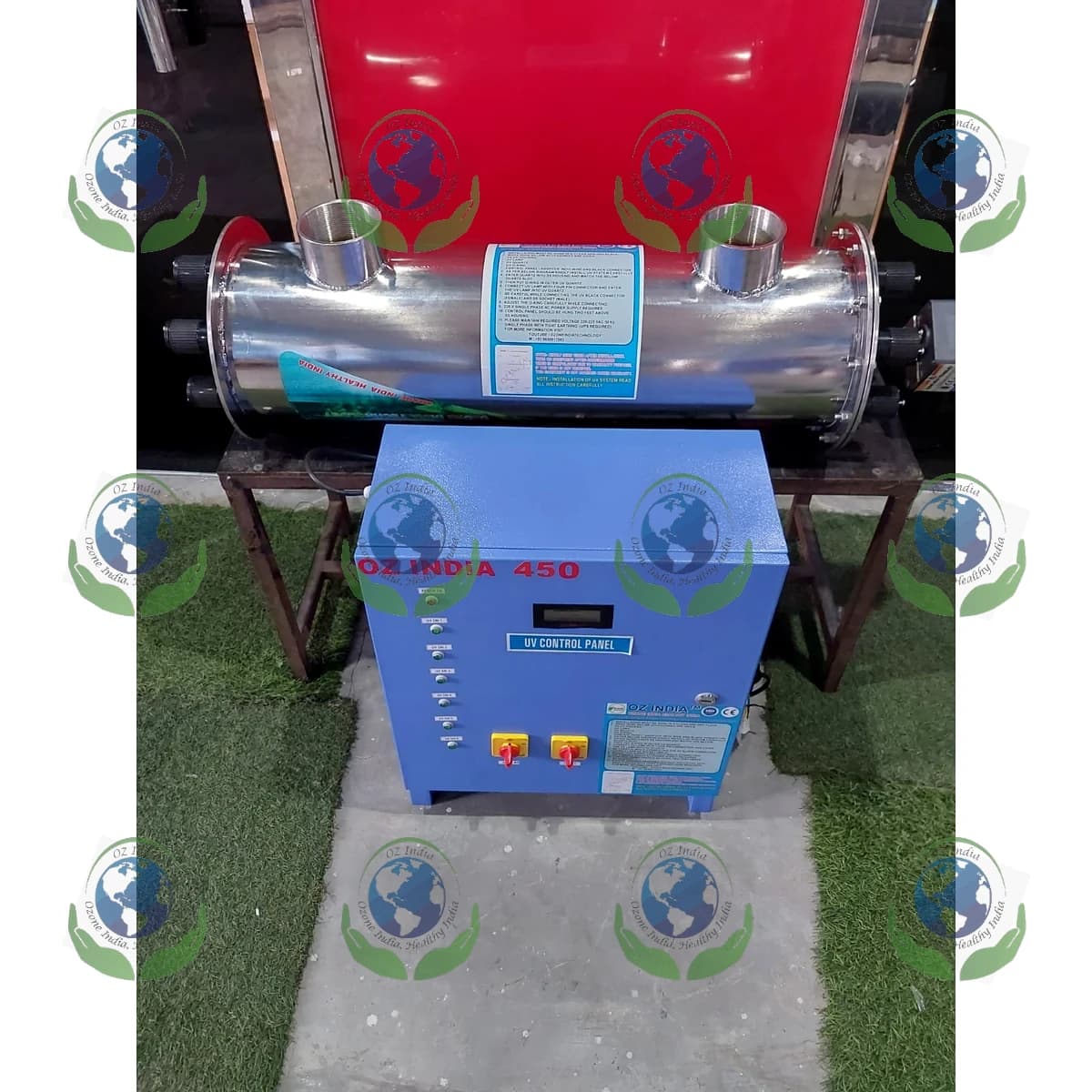
High-flow UV water treatment for pharmaceutical WFI, food & beverage process water, and industrial applications. Revised Schedule M 2025, HACCP, and FSSAI compliant. IQ/OQ/PQ documentation.
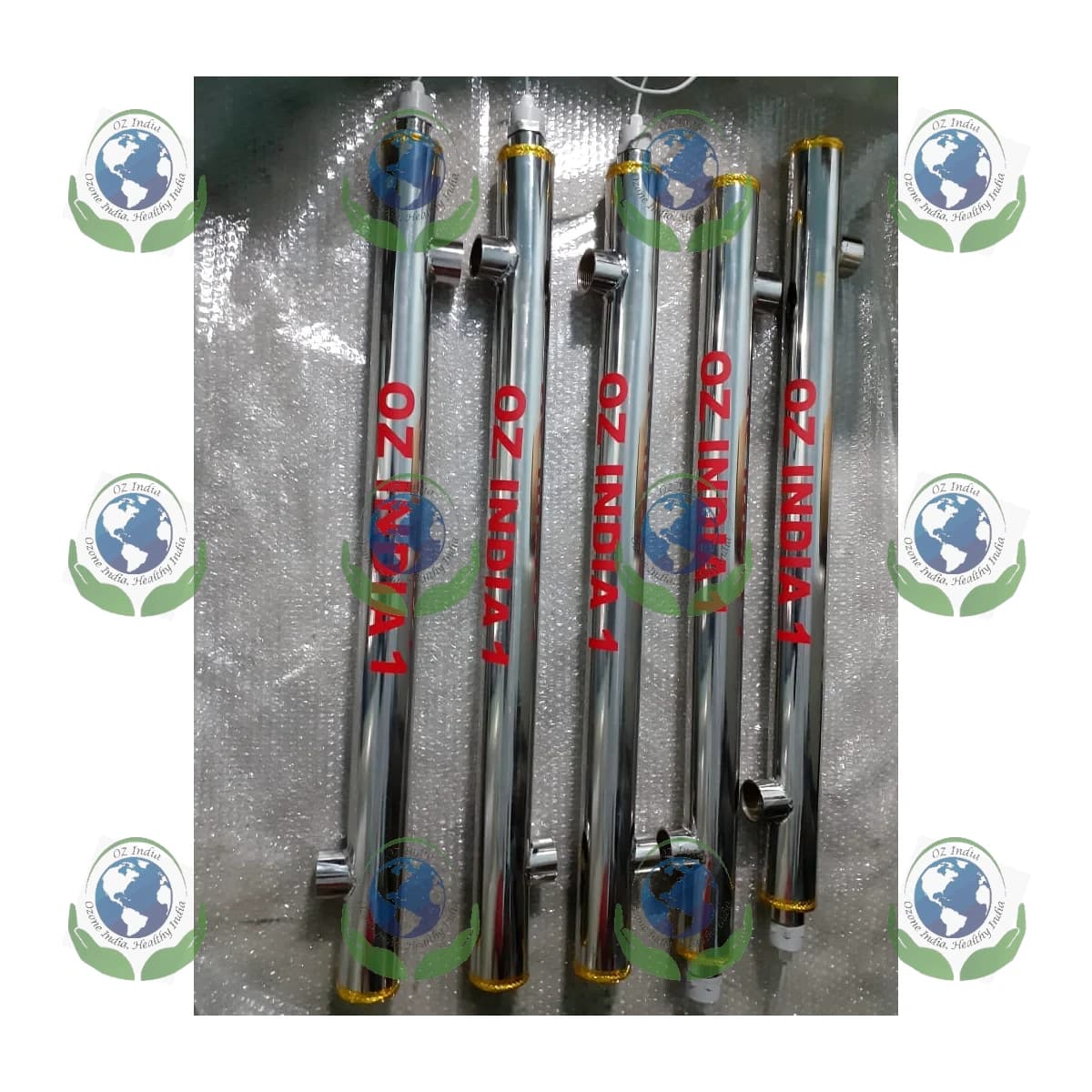
UV water disinfection for hotels, restaurants, offices, and educational institutions. HACCP and FSSAI compliant documentation. Trusted by Taj Hotels, McDonald's India, and IIT Kanpur.
IIT Patna Engineering
Alpha UV System IIT Patna engineers calculate UV dose from your actual water quality parameters — measured UVT, flow rate, target log reduction, and the specific compliance standard that governs your facility. Not from catalogue sizing tables or generic assumptions. Every system ships with a signed UV dose calculation report, a Philips certificate of authenticity, and compliance documentation prepared for the regulatory framework applicable to dairy uv operations.
From measured UVT, flow rate, and target log-reduction. Signed by IIT Patna engineer.
FSSAI · HACCP · IS 1479 · Codex STAN 193 — documentation prepared to the audit checklist, not generic templates.
WhatsApp your flow rate, water quality, and compliance requirement — engineering-backed quote in 2 hours.
Mon–Sat · 9 AM–6 PM IST · IIT Patna alumni on call
Send us your flow rate and compliance requirement — quote with engineering rationale in 2 hours.
+91 93183 05878
Get Quote →
Call Direct
+91 95995 00580
Tap to Call →
Send Enquiry
Detailed specifications form
Open Form →
