Manufactured in Greater NoidaGenuine Philips UV-C LampsIIT Patna Alumni on Our TeamExporting to 20+ Countries
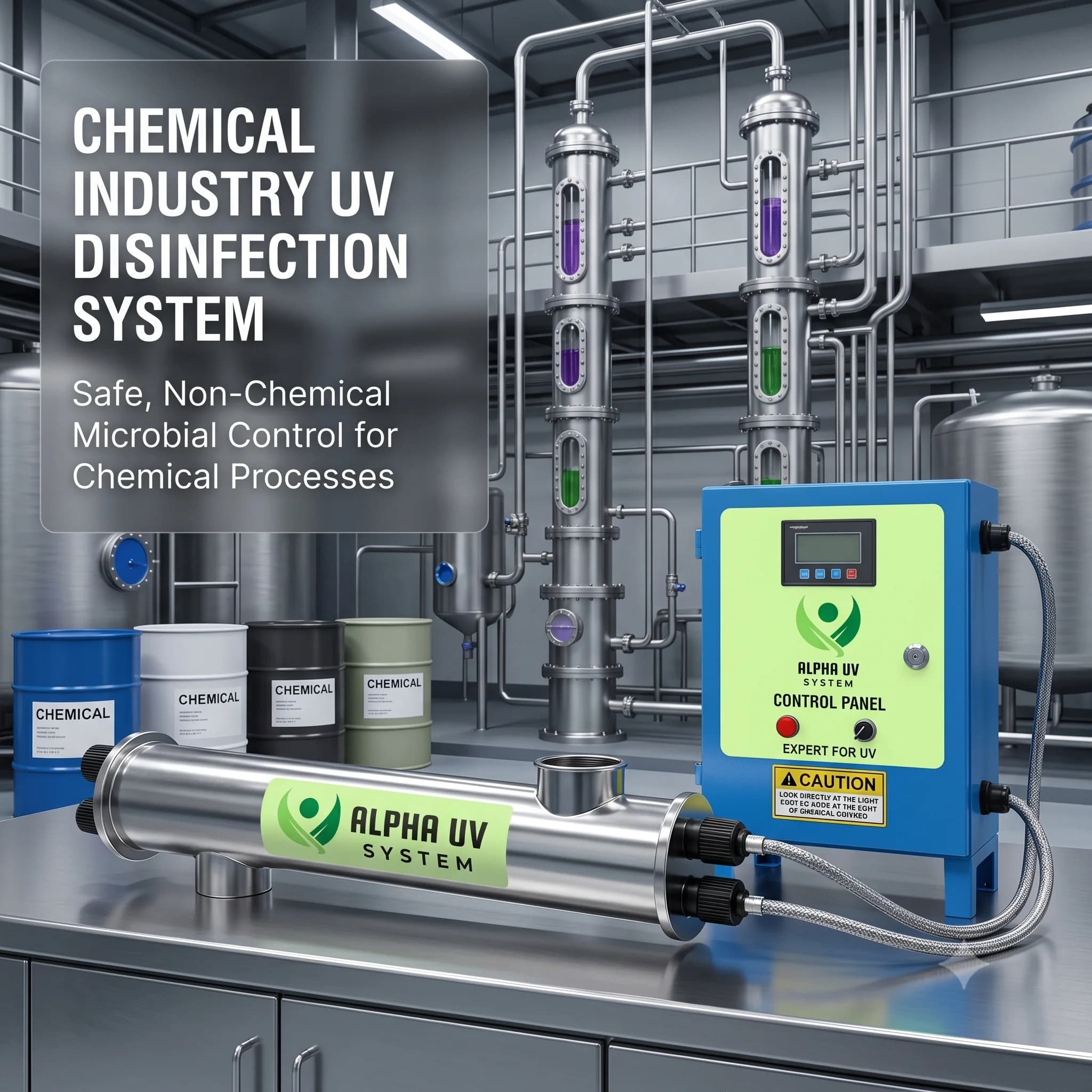
Chemical manufacturing plants operate some of India's most demanding water treatment environments — process water must be microbiologically pure to prevent interference with chemical reactions, cooling tower water must be controlled for Legionella, and ETP effluent must meet CPCB discharge norms before release. Alpha UV System supplies chemical-grade UV disinfection systems built from 316L stainless steel with PTFE seals and IP66 enclosures, engineered to operate reliably in chemical plant environments where standard UV materials would fail. Our units serve chemical, specialty chemical, agrochemical, dye, and polymer manufacturers across India from 5,000 to 1,00,000 LPH.
UV Dose
40–80 mJ/cm²
Capacity
5,000 – 1,00,000 LPH
The chemical manufacturing sector in India spans a remarkable diversity of production types — bulk organic chemicals, specialty chemicals and dyes, agrochemicals, polymers and plastics, paints and coatings, inorganic chemicals, and active pharmaceutical ingredients (APIs). Each segment has distinct process water quality requirements, but all share a common challenge: water used in chemical production must be microbiologically controlled to prevent interference with chemical reactions, contamination of products, and biofilm fouling of process equipment.
For specialty chemical and agrochemical manufacturers, process water used as a reaction solvent, emulsification medium, or formulation diluent must be essentially free of microorganisms. Bacterial contamination of process water introduces enzymes, organic metabolites, and endotoxins that can interfere with chemical synthesis reactions, degrade certain chemical products through enzymatic activity, or contaminate formulated agrochemicals with biological matter that affects product performance and registration compliance. UV disinfection at 40 mJ/cm² eliminates greater than 4-log (99.99%) of all bacteria from process water in a single pass, without adding any chemical residual that could interfere with product chemistry.
For API and pharmaceutical chemical manufacturers, the process water standard is even more demanding — USP Purified Water or Water for Injection quality, with microbial counts below 1 CFU/mL and absence of all specified pathogens. UV disinfection is a mandatory component of pharmaceutical water systems, positioned as a final polishing step after reverse osmosis to eliminate the trace bacteria that pass through RO membranes. Alpha UV System's pharmaceutical-grade UV units are available with IQ/OQ/PQ documentation packages for Schedule M GMP compliance, enabling use in API plant water systems directly.
Chemical plant effluent treatment plants (ETPs) must meet Central Pollution Control Board (CPCB) discharge standards before releasing treated effluent to receiving water bodies, municipal sewers, or land. The Environment Protection Act 1986, Schedule VI General Standards for Discharge of Environmental Pollutants specify — for surface water discharge — BOD ≤30 mg/L, COD ≤250 mg/L, suspended solids ≤100 mg/L, and total coliforms ≤100 MPN/100 mL. Many chemical plant ETPs achieve BOD and COD targets through biological treatment (activated sludge, MBBR) but struggle with the coliform limit, especially during biological treatment process upsets.
UV disinfection as a final ETP polishing stage after secondary clarification provides reliable, continuous disinfection of treated effluent to achieve CPCB coliform standards without chemical residuals. This is particularly important for chemical plants because effluent disinfection with chlorine creates chlorinated organic by-products (chlorinated phenols, THMs, haloacetic acids) when chlorine reacts with complex organic molecules in chemical plant effluent — some of which are more toxic or carcinogenic than the original effluent. UV avoids this secondary contamination entirely. The USEPA UV Disinfection Guidance Manual (EPA 815-R-06-007, 2006) and WHO Water Quality Guidelines confirm that UV at 40–60 mJ/cm² is effective for disinfection of secondary-treated industrial effluent with UVT above 65%.
Chemical plants with large cooling tower systems — common in petroleum refining, chemical processing, and power generation for self-use — face Legionella pneumophila risk in their cooling water circuits. Cooling towers are identified in ASHRAE Standard 188-2018 (Legionellosis: Risk Management for Building Water Systems) as a primary amplifier for Legionella, particularly in warm climates where tower water temperatures remain in the Legionella growth range (25–45°C) year-round.
Traditional cooling tower biocide programs using chlorine or bromine-based oxidising biocides and non-oxidising biocides (isothiazolinones) are effective but expensive — ₹4–12 lakh per year for medium-to-large industrial cooling towers. These programs generate chemical waste requiring disposal, create documentation obligations under Hazardous Chemicals Management Rules, and — when chlorine reacts with cooling water organics — produce chlorinated organic disinfection by-products in blowdown water that complicates ETP discharge compliance. UV treatment of cooling tower make-up water and side-stream recirculation treats the biological challenge at source, typically reducing biocide consumption by 50–70% while maintaining Legionella at counts below 10 CFU/L in the treated water stream.
UV disinfection performance is directly determined by the UV transmittance (UVT) of the water at 254 nm. Higher UVT means more UV energy reaches the microorganisms — allowing a smaller UV chamber to deliver the required dose. Lower UVT (caused by dissolved organics, colour, turbidity, or dissolved iron and manganese) means more UV energy is absorbed by the water itself before reaching pathogens, requiring either a larger UV system or improved pre-treatment to raise UVT.
Chemical plant process water streams vary widely in UVT:
Alpha UV System performs UVT analysis on water samples from each proposed installation point before specifying UV equipment. This ensures the UV system is sized for the actual water quality at the installation site, not an assumed value, and that pre-treatment recommendations are provided when UVT falls below the level needed for the target dose.
The most critical engineering difference between standard UV systems and chemical-grade UV systems is material selection. Chemical plant environments expose equipment to acid and solvent splash, vapour atmospheres that degrade polymers, and aggressive cleaning chemicals during maintenance. Standard UV systems built with ABS control panels, NBR seals, and BSP-threaded fittings are inadequate for chemical plant service.
Alpha UV System's chemical-grade UV units are specified with 316L stainless-steel reactor chambers (not 304 SS), PTFE or EPDM seals selected for the specific chemical environment, PVDF or stainless-steel inlet/outlet connections, IP66 stainless-steel control panel enclosures, ceramic lamp holders (replacing polymer), and quartz sleeve holders constructed from PTFE or stainless steel. For environments handling chlorinated solvents, strong acids, or corrosive inorganic chemicals, Hastelloy C-276 reactor chambers and titanium components are available. ATEX Zone 1 and Zone 2 certified versions are available for installations in classified hazardous areas near solvent storage, reactor areas, or vapour-generating process equipment.
The importance of correct material selection is reinforced by published corrosion engineering data. The Parker O-Ring Chemical Resistance Guide and Cole-Parmer Chemical Compatibility data confirm that NBR seals are not resistant to ketones, esters, aromatic hydrocarbons, or strong oxidising acids — all common in chemical manufacturing environments. PTFE, by contrast, is resistant to virtually all chemical environments including concentrated sulphuric acid, hydrochloric acid, organic solvents, and oxidising agents. Alpha UV System specifies PTFE seals as standard for all chemical industry installations.
The total cost of ownership analysis over five years consistently favours UV disinfection over chemical biocide treatment for most chemical plant water treatment applications. The capital cost of UV is higher than simple chemical dosing (₹3–8 lakh installed vs ₹0.5–1 lakh for a basic chlorine dosing system), but the annual operating cost is dramatically lower. Chlorine-based biocide programs for a 20,000 LPH chemical plant water circuit typically cost ₹8–12 lakh per year when all costs are included: chemical purchase (sodium hypochlorite), chemical storage infrastructure, dosing pump maintenance, neutraliser chemicals, and wastewater handling for excess chlorine. UV operating costs for the same application are ₹1.5–2.5 lakh per year: lamp power consumption, annual lamp replacement, and quartz sleeve cleaning.
At these cost differentials, the UV system capital outlay is recovered in less than six months of operating cost savings. Over five years, the cumulative cost advantage of UV over chlorination for a 20,000 LPH chemical plant application is typically ₹30–40 lakh. Additional financial benefits include: reduced CPCB monitoring costs (UV-treated ETP discharge is consistently compliant, reducing frequency and complexity of consent-to-operate renewals), elimination of chemical storage and handling liability, and avoidance of chlorinated DBP formation that would complicate ETP discharge and potentially trigger additional CPCB monitoring requirements.
Chemical manufacturers with export customers face a layered regulatory framework for water treatment. Domestic environmental compliance is governed by the Environment Protection Act 1986, the Water (Prevention and Control of Pollution) Act 1974, and CPCB effluent discharge standards. ISO 14001 environmental management system certification — required by many European and US chemical buyers as a supplier qualification condition — requires documented monitoring and control of environmental aspects including water use, wastewater quality, and chemical inputs to water treatment. UV disinfection, with its continuous intensity monitoring and data logging, provides directly auditable environmental management records for ISO 14001 compliance.
For chemical exporters subject to EU REACH Regulation (Registration, Evaluation, Authorisation and Restriction of Chemicals), the absence of chemical biocides in the process water treatment system simplifies REACH substance reporting for production facility inputs. UV disinfection introduces no chemical substances to the production environment, eliminating biocide from the list of substances requiring REACH evaluation. The WHO Guidelines for Drinking Water Quality, 4th Ed. (2017) and USEPA UV Disinfection Guidance Manual (EPA 815-R-06-007, 2006) both confirm UV as a primary disinfection technology with the most favourable regulatory profile across all major regulatory frameworks globally.
Specialty Chemicals and Dyes: Process water for dyestuff dissolution, pigment dispersion, and reaction media must be bacteria-free to prevent biological degradation of sensitive organic dye molecules. UV at 40 mJ/cm² on process water feed lines ensures no biological interference with dyestuff chemistry. Cooling tower side-stream UV reduces biofouling in heat exchangers serving dye reactor cooling circuits.
Agrochemical Formulation: Emulsifiable concentrates, suspension concentrates, and water-dispersible granule formulations use water as the formulation medium. Biological contamination of formulation water can affect product performance in field trials and raises concerns with pesticide registering authorities. UV-treated process water ensures biological quality consistent with pesticide product registration requirements.
Polymer and Plastics: Reactor cooling water, quench water for extruders, and pellet spray cooling water must be maintained at low total plate counts to prevent biofilm formation in cooling circuits that increases thermal resistance and reduces production throughput. UV on cooling water make-up and side-stream extends intervals between heat exchanger cleaning from quarterly to annually in many installations.
Paints and Coatings: Water-based paint formulations use process water that directly becomes part of the product. Bacterial contamination of paint process water can cause product spoilage, pigment settling, and viscosity changes. UV treatment of paint process water at the formulation stage is standard practice in export-quality water-based paint manufacturing.
Alpha UV System's IIT Patna-trained engineers conduct site assessments for chemical industry UV installations, including water quality analysis (UVT measurement, turbidity, colour), flow rate confirmation, installation point selection, and material compatibility review. Commissioning includes dose validation at the installed flow rate, UVT measurement of the actual water stream, and initial microbial testing to confirm target reductions are achieved.
For ongoing support, Alpha UV System provides annual lamp replacement services (quartz sleeves inspected and cleaned or replaced at the same time), calibration of UV intensity sensors, and technical advice on maintaining water quality within the UV system's design parameters. 24–48 hour response to technical enquiries during production operations. Contact our technical team via WhatsApp 9318305878 for chemical industry UV specifications and pricing.
Recommended Products
IIT Patna engineers recommend these systems for chemical industry uv applications based on flow rate, required UV dose, and compliance standard. Both systems use genuine Philips UV-C lamps and ship with complete compliance documentation.
IIT Patna Engineering
Alpha UV System IIT Patna engineers calculate UV dose from your actual water quality parameters — measured UVT, flow rate, target log reduction, and the specific compliance standard that governs your facility. Not from catalogue sizing tables or generic assumptions. Every system ships with a signed UV dose calculation report, a Philips certificate of authenticity, and compliance documentation prepared for the regulatory framework applicable to chemical industry uv operations.
From measured UVT, flow rate, and target log-reduction. Signed by IIT Patna engineer.
CPCB ETP Norms · ISO 14001 · IS 10500 · REACH Export — documentation prepared to the audit checklist, not generic templates.
WhatsApp your flow rate, water quality, and compliance requirement — engineering-backed quote in 2 hours.
Mon–Sat · 9 AM–6 PM IST · IIT Patna alumni on call
Send us your flow rate and compliance requirement — quote with engineering rationale in 2 hours.
+91 93183 05878
Get Quote →
Call Direct
+91 95995 00580
Tap to Call →
Send Enquiry
Detailed specifications form
Open Form →