Quick Answer
UVGI AHU duct systems for Delhi NCR facility managers work by installing Philips UV-C lamps inside air handling units to irradiate cooling coils, drain pans, and the passing airstream — inactivating bacteria, mould, and viruses at the source before conditioned air enters occupied spaces. In Delhi NCR's high-PM2.5, high-humidity environment, UVGI is the single highest-ROI HVAC upgrade available for commercial buildings, delivering both pathogen control and measurable energy savings from cleaner coils. Correctly sized UVGI HVAC India systems typically recover their capital cost within 18 to 24 months through reduced chiller energy and eliminated chemical coil cleaning.
What UVGI Does in an HVAC System
Ultraviolet germicidal irradiation applied to HVAC systems works through two distinct mechanisms. Understanding which mechanism is required — and where lamps must therefore be positioned — is the most important engineering decision in any UVGI commercial building India project. Facility managers who conflate the two modes frequently end up with an undersized or incorrectly located system that fails to deliver the expected results.
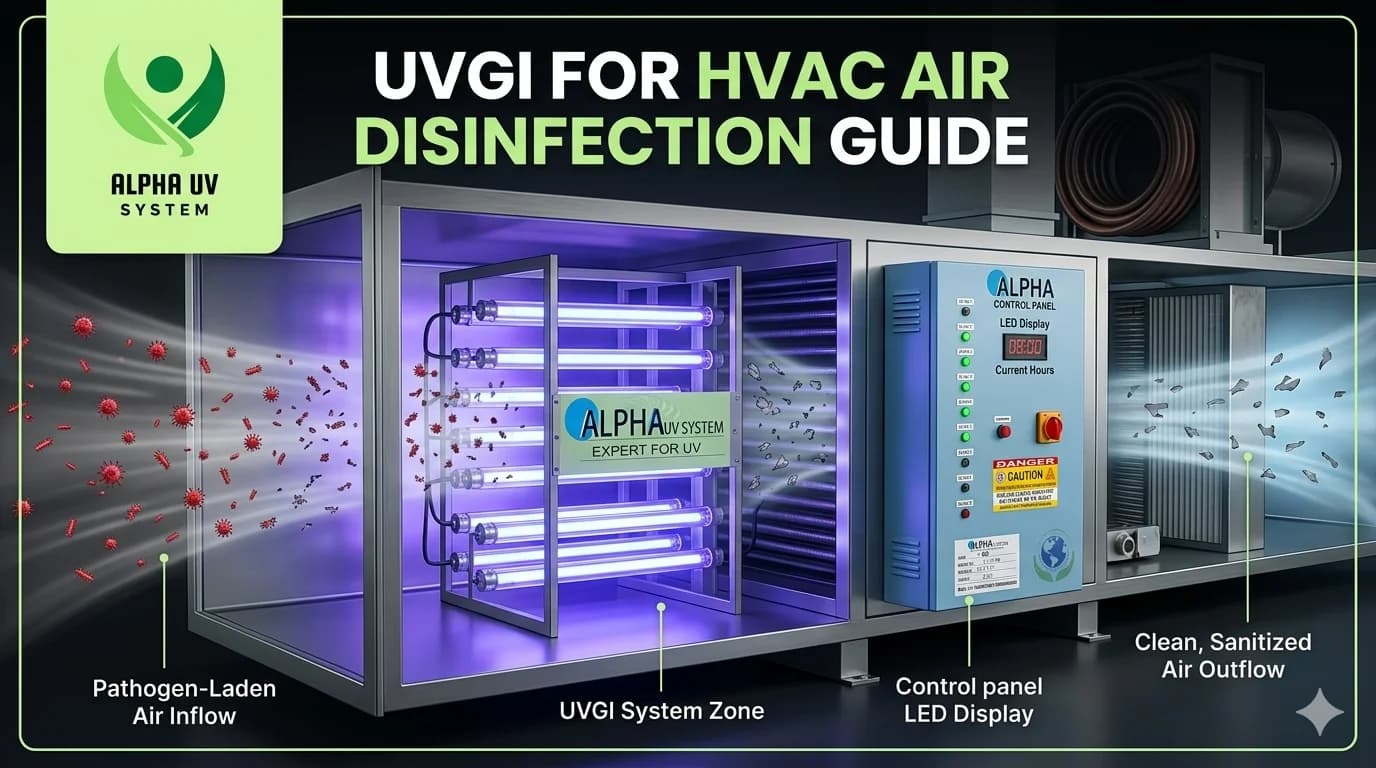
Coil irradiation (surface UVGI): Philips UV-C lamps are mounted to continuously irradiate the cooling coil face and drain pan surfaces. Cooling coils and drain pans are the primary sites of biofilm accumulation in any AHU. Moisture, warmth, and organic particulate loading from Delhi NCR's polluted ambient air create near-ideal conditions for Legionella pneumophila, Aspergillus, Cladosporium, and gram-negative bacteria to colonise coil fins and drain pan walls. UV coil irradiation Delhi projects target this biofilm directly: the UV-C dose required is lower than airstream UVGI because the surface dwell time is effectively infinite — the lamp irradiates the biofilm continuously, not in the fraction-of-a-second exposure that a moving airstream receives. Coil UVGI simultaneously eliminates biofilm as an airborne contamination source and restores heat transfer efficiency degraded by fouling.
Airstream irradiation (duct UVGI): UV-C lamp arrays are installed in the supply duct or AHU mixing chamber to irradiate air as it passes through at design velocity. This inactivates airborne pathogens — bacteria, viruses, and fungal spores carried in the airstream — before they reach the supply diffusers. Airstream UVGI requires substantially higher lamp power than coil UVGI because the exposure time is limited to the air's transit time past the lamps, typically 0.1 to 0.5 seconds at design velocity. A UVGI HVAC India system for airstream disinfection in a 10,000 CFM AHU demands an engineered lamp array calculated to deliver the required UV dose at that specific velocity.
For most commercial building applications — offices in Gurugram, malls in Noida, hotels in Aerocity — coil irradiation is the starting point and delivers the most favourable ROI. For healthcare, pharmaceutical clean rooms, and high-density occupancy venues with post-COVID air quality commitments, both coil and airstream UVGI are combined into a dual-mode AHU UV disinfection system.
Delhi NCR-Specific Drivers: Why UVGI Is Urgent Here
UVGI AHU duct Delhi NCR facility managers operate in one of the most demanding HVAC environments in the world. The confluence of extreme pollution, tropical humidity, and dense commercial real estate creates conditions that make UVGI not merely advantageous but operationally necessary.
PM2.5 and coil fouling rate: Delhi's annual average PM2.5 regularly exceeds 90 ug/m3 — five to six times WHO guidelines. Even with pre-filters, HVAC coils in Delhi NCR accumulate particulate at a rate two to three times higher than buildings in cities such as Pune or Bengaluru. This particulate load is the organic substrate on which biofilm grows. AHU UV disinfection systems in Delhi NCR therefore face a higher-than-average biological challenge and deliver proportionally higher benefit per rupee of capital deployed.
Monsoon mould season: The July to September monsoon period brings sustained relative humidity above 80% across Noida, Greater Noida, Faridabad, and Ghaziabad. Cooling coils operating at 7 to 12 degrees Celsius surface temperature in 80% RH air are continuously at risk of surface condensation — creating a mould growth environment even between AHU operating cycles. HVAC UV system NCR installations that operate 24 hours a day through the monsoon prevent the seasonal mould loading that would otherwise be distributed through every supply diffuser in the building.
Commercial occupancy density: Delhi NCR's office parks — DLF Cyber City in Gurugram, Sector 62 corporate campuses in Noida, World Trade Centre in Badarpur — achieve occupancy densities of 80 to 120 persons per 1,000 sq ft. At these densities, airborne transmission of respiratory pathogens is a documented operational risk. Post-2020, building management agreements for institutional tenants in these campuses increasingly require documented UVGI installation India records as part of air quality compliance.
Legionella risk window: Delhi NCR summer temperatures from April through October create a sustained Legionella-favourable environment. Drain pans that hold standing water above 25 degrees Celsius between AHU cycles are classified as Legionella risk points under ASHRAE Guideline 12 and ASHRAE 188. CPWD-operated buildings and NBC-compliant new construction projects in the NCR region are now expected to document Legionella control measures — UV coil irradiation Delhi systems satisfy this requirement at lower operational cost than continuous biocide dosing.
UVGI in HVAC — Two Installation Modes
The table below sets out the engineering differences between coil irradiation and airstream irradiation that determine system selection for a given building type and risk profile.
| Parameter | Coil Irradiation | Airstream Irradiation |
|---|---|---|
| Primary purpose | Biofilm elimination on coil and drain pan surfaces | Inactivation of airborne pathogens in the moving airstream |
| Lamp position | Mounted in coil plenum, parallel to coil face, 150–300 mm from coil | Mounted perpendicular to airflow in duct or mixing chamber |
| Pathogen target | Legionella, Aspergillus, Cladosporium, gram-negative bacteria in biofilm | Influenza, SARS-CoV-2, tuberculosis, measles in aerosol phase |
| UV dose requirement | Lower — continuous exposure compensates for lower irradiance | High — must achieve target dose in 0.1–0.5 second transit time |
| Lamp operation mode | 24-hour continuous, including when AHU is off | Operates only when AHU fan is running |
| Typical applications | Commercial offices, hotels, malls, data centres, Gurugram/Noida campuses | Hospital wards, isolation rooms, pharma clean rooms, dense-occupancy venues |
| Energy impact | Net positive: coil cleaning saves 10–15% heat transfer loss from biofilm | Net neutral to slightly positive: lamp power is offset by reduced filtration load |
| Indian buildings using it | Corporate campuses, 5-star hotel groups, BEE-rated green buildings | NABH-accredited hospitals, pharmaceutical GMP facilities, airport terminals |
ASHRAE and BIS Standards for UVGI in HVAC
Compliance documentation is increasingly required by institutional tenants, insurance underwriters, and accreditation bodies. The following standards govern UVGI installation India and directly apply to AHU UV disinfection projects in Delhi NCR commercial buildings.
| Standard | What It Covers | Key Requirement | Applicability to India |
|---|---|---|---|
| ASHRAE 185.1-2020 | Testing UV lamps for HVAC duct applications | Defines test procedures for UV output, lamp life, and dose verification in moving air | Referenced by LEED v4.1 and WELL Building Standard for Indian projects |
| ASHRAE 188-2021 | Legionella risk management in building water and HVAC systems | Requires water management plan; recommends UVGI for coil and drain pan disinfection | Adopted by hospital chains and 5-star hotel groups operating under international brand standards in NCR |
| ASHRAE HVAC Applications Ch. 62 | UVGI system design for HVAC: dose calculation, lamp placement, safety | Engineering methodology for irradiance x exposure time dose calculations at design airflow | Design basis for UVGI HVAC India engineering proposals and tender documents |
| ASHRAE Guideline 12 | Minimising risk of Legionellosis from HVAC cooling towers and AHUs | Lists UVGI as a validated Legionella control measure for AHU drain pans | Used by CPWD and NBC-compliant projects in Delhi NCR as Legionella risk documentation |
| NBC 2016 Part 8 | National Building Code — HVAC system requirements for Indian buildings | Mandates ventilation air quality standards; UVGI is cited as a supplementary disinfection method | Binding for new construction and major HVAC retrofits in all Indian jurisdictions |
| BEE Star Rating Programme | Bureau of Energy Efficiency ratings for commercial buildings | Coil UVGI qualifies as an energy conservation measure improving HVAC seasonal COP | Relevant for 3-star and above BEE-rated office buildings seeking rating upgrades |
Benefits of UVGI for Delhi NCR Commercial Buildings
Airborne Pathogen Inactivation
Post-COVID building occupancy agreements in Gurugram and Noida office parks increasingly include air quality annexures requiring documented pathogen control measures. AHU UV disinfection systems provide verifiable, continuous protection that passive filtration alone cannot guarantee. UVGI HVAC India installations achieving a 90% (1-log) inactivation of airborne influenza at design airflow are achievable with correctly sized lamp arrays. For SARS-CoV-2 and similar enveloped viruses, UV-C dose requirements are lower, meaning adequate coil UVGI systems deliver meaningful airstream disinfection as a secondary benefit even when configured primarily for surface sterilisation.
Mould Prevention on Cooling Coils — Monsoon Season
Delhi NCR facility managers who have opened AHU coil plenums in October — at the end of the monsoon season — understand the scale of seasonal mould accumulation. Black and grey mould colonies visible on coil fins and in drain pans are not merely an aesthetic problem: they shed spores continuously into the supply air during AHU operation, contributing to sick building syndrome complaints, asthma exacerbations, and mycotoxin exposure in enclosed spaces. HVAC UV system NCR installations operating continuously through July to September prevent this seasonal cycle entirely. Buildings with coil UVGI in place consistently show near-zero mould colony counts in post-monsoon coil inspections compared to untreated AHUs in the same property.
Energy Savings from Clean Coils
Biofilm on cooling coil fins acts as a thermal insulation layer. A 0.1 mm biofilm layer can reduce coil heat transfer efficiency by 10 to 15%. In a 200-tonne HVAC system, this directly increases compressor work to maintain set-point supply air temperature — raising chiller energy consumption by 5 to 10% annually. UV coil irradiation Delhi systems that maintain clean coil surfaces restore this lost efficiency continuously, without the periodic step-change recovery achieved by annual chemical coil cleaning. BEE-rated buildings in Noida's Sector 62 and Gurugram's DLF zones that have commissioned coil UVGI as part of energy audits have documented measurable chiller kWh reductions in the 12 months post-installation.
Odour Reduction from Drain Pan Bacteria
The musty, stale-air odour that occupants in older commercial buildings associate with air conditioning is almost always traceable to drain pan bacterial colonies producing volatile organic compounds — particularly during the monsoon when drain pan water temperatures are elevated. UVGI eliminates drain pan biofilm, removing the odour source at origin rather than masking it with air fresheners. This is a direct occupant experience improvement that building managers can communicate to tenants within the first operational month after UVGI installation.
LEED and WELL Building Certification Points
LEED v4.1 Indoor Environmental Quality credits and WELL Building Standard v2 Air Feature A07 (Reduction of Airborne Contaminants) both provide certification points for UVGI HVAC India systems meeting documented performance criteria. For corporate campuses in Noida and Greater Noida pursuing LEED Gold or WELL certification, UVGI installation India provides one of the most cost-efficient paths to IEQ credits — particularly when the system also contributes to energy credits through improved coil efficiency.
UVGI Benefits — Quantified for Delhi NCR Commercial Buildings
| Benefit | Measurement | Typical Improvement | Annual Saving Estimate (200T system) |
|---|---|---|---|
| Coil heat transfer restoration | % increase in coil U-value vs fouled baseline | 10–15% heat transfer improvement | Rs 1,50,000–3,00,000 chiller energy reduction |
| Chemical coil cleaning eliminated | Number of annual coil wash cycles avoided | 2–3 chemical washes/year eliminated | Rs 40,000–80,000 chemical and labour cost saving |
| Airborne pathogen inactivation | Log-reduction of viable airborne organisms at supply grille | 1–2 log reduction (90–99%) for bacteria and enveloped viruses | Qualitative: reduced sick leave, tenant retention premium |
| Mould spore suppression | CFU/m3 in supply air (post-monsoon) | Near-zero coil mould vs untreated AHUs in same building | Rs 20,000–60,000 remediation cost avoided |
| Filter life extension | Months between G4/F7 filter replacements | 20–30% extension in filter replacement intervals | Rs 15,000–35,000 filter material cost reduction |
| LEED / WELL certification credits | IEQ credit points earned | 2–4 IEQ credit points toward Gold/Platinum certification | Enables higher rental yield — certified buildings command 8–12% premium in NCR |
Lamp Selection for HVAC UVGI Applications
Philips TUV low-pressure UV-C lamps are the engineering-standard choice for UVGI AHU duct Delhi NCR facility manager projects. Philips TUV lamps emit approximately 85% of their UV output at 253.7 nm — the wavelength with peak germicidal effectiveness. For UVGI HVAC India applications, lamp selection is governed by three interdependent parameters: physical fit, UV output (watts UV-C), and operating temperature.
Physical fit: The lamp must span the full coil width in coil irradiation mode, or the full duct width in airstream mode, without mechanical contact with coil fins, duct walls, or support structures. AHU coil plena in Delhi NCR commercial buildings typically range from 600 mm to 2,400 mm in coil width. Philips TUV lamps are available in lengths from 212 mm to 1,500 mm; multiple lamps in series or parallel arrays cover larger dimensions.
Operating temperature: Low-pressure mercury UV-C lamps — including Philips TUV — have peak UV output at approximately 40 degrees Celsius lamp wall temperature. In an AHU coil plenum, leaving air temperatures of 7 to 13 degrees Celsius during peak cooling operation can reduce lamp wall temperature significantly below optimal. When plenum temperatures are expected to drop below 20 degrees Celsius, cold-cathode UV-C variants are specified. Alpha UV System selects the correct Philips UV-C lamp variant based on measured or design AHU operating temperatures for each specific NCR installation site.
UV output verification: Lamp UV output decays over operating hours. Philips TUV lamp specifications state output at 2,000 hours (roughly 25% decay from initial). For coil irradiation applications, this decay is typically acceptable within a 9,000-hour lamp life. For airstream UVGI applications where dose delivery at design airflow is critical, lamp replacement schedules must be aligned with output decay to maintain guaranteed log-reduction performance.
AHU Sizing Calculation — How UV Dose Is Calculated for HVAC
UVGI dose in HVAC applications is calculated differently from water UV disinfection. Water UV systems express dose in mJ/cm2 for a static volume. HVAC UVGI expresses performance as irradiance (microWatts per cm2) at a surface or in an airstream, combined with exposure time (seconds at design airflow velocity). The product of irradiance and exposure time gives effective dose for airstream applications.
For coil irradiation, the calculation is simpler: the lamp must deliver a minimum irradiance of 75 to 100 microWatts/cm2 at the coil surface — sufficient to prevent biofilm regrowth under continuous exposure. This irradiance is governed by lamp output (UV watts), lamp-to-coil distance, and the inverse-square law for UV attenuation. An IIT-trained engineering assessment of each AHU's coil geometry and plenum dimensions is required to confirm lamp count and positioning.
For airstream UVGI, the design calculation is: Required dose (mJ/cm2) = Irradiance (uW/cm2) x Exposure time (seconds). Exposure time = lamp bank length (m) / air velocity (m/s). For a 10,000 CFM AHU with a 600 mm x 600 mm duct cross-section, air velocity is approximately 4.7 m/s. A 300 mm lamp bank gives 0.064 seconds exposure. Achieving a 6 mJ/cm2 dose for 90% inactivation of influenza therefore requires approximately 94 uW/cm2 irradiance at the centre of the duct — a multi-lamp array calculation.
UVGI Sizing Reference — Delhi NCR Commercial Building Types
| Building Type | AHU Capacity | Coil Area (m2) | Recommended UVGI Configuration | Lamp Wattage |
|---|---|---|---|---|
| Corporate office (Gurugram/Noida) | 5,000–10,000 CFM | 0.6–1.2 m2 | 2x Philips TUV coil irradiation, single lamp row | 2 x 55W |
| 5-star hotel (Aerocity/Sector 29 Gurugram) | 15,000–25,000 CFM | 2.0–3.5 m2 | 4x Philips TUV coil + 2x airstream duct array | 4 x 75W + 2 x 75W |
| Hospital (NABH-accredited, NCR) | 8,000–20,000 CFM per AHU | 1.0–2.5 m2 | Dual-mode: coil + high-intensity airstream array for 2-log reduction | 3 x 95W coil + 4 x 95W airstream |
| Retail mall (Noida/Greater Noida) | 30,000–60,000 CFM | 4.0–8.0 m2 | 6–8x Philips TUV coil irradiation, two lamp rows staggered | 8 x 75W |
| Pharmaceutical GMP (Greater Noida/Faridabad) | 10,000–30,000 CFM | 1.5–4.0 m2 | Dual-mode with redundant lamp circuit and alarm on lamp failure | 4 x 95W + backup circuit |
| Data centre (Ghaziabad/Noida corridor) | 20,000–50,000 CFM precision cooling | 2.5–6.0 m2 | Coil irradiation only — airstream not required; ballasts outside AHU cabinet | 4–6 x 75W |
Installation Checklist for Delhi NCR Facility Managers
The following checklist covers the end-to-end process for a UVGI AHU duct Delhi NCR facility manager project from site survey through commissioning and handover. Each step is mandatory for a safe, compliant, and warrantable installation.
| Step | Action | Who Performs | Timeline | Documentation |
|---|---|---|---|---|
| 1 | AHU site survey: measure coil dimensions, plenum depth, airflow velocity, electrical supply available | Alpha UV System engineering team | 24–48 hour response from enquiry | Site survey report with AHU drawings |
| 2 | UV dose calculation: irradiance model for selected lamp count, position, and AHU geometry | IIT-trained application engineer | 3–5 working days post survey | Engineering calculation sheet, lamp placement drawing |
| 3 | Safety interlock design: door switch wiring diagram, lamp-off confirmation relay selection | Alpha UV System electrical team | Included in Step 2 deliverable | Interlock wiring schematic |
| 4 | AHU isolation and lockout/tagout: confirm AHU is de-energised and fanned-off before access | Facility manager / HVAC contractor | Installation day, prior to team entry | Permit to work, LOTO sign-off sheet |
| 5 | Lamp mounting: lamp holders, UV-rated cable, ballast positioning outside AHU cabinet | Alpha UV System installation team | 4–8 hours per AHU depending on size | Installation photographs, lamp serial numbers logged |
| 6 | Viewing window upgrade: replace standard inspection glass with UV-blocking polycarbonate or UV-filter film | Alpha UV System / AHU OEM | Same installation visit | UV-blocking material certification |
| 7 | Commissioning: lamp-on test, interlock function verification, UV irradiance spot measurement at coil face | Alpha UV System commissioning engineer | Post installation, same day | Commissioning report with UV meter readings |
| 8 | Facility team training: lamp replacement procedure, interlock test protocol, lamp hour logging | Alpha UV System commissioning engineer | 1–2 hours post commissioning | Training sign-off sheet, O&M manual handover |
Safety Requirements for UVGI in AHU and Duct
UV-C radiation at 253.7 nm causes corneal burns (photokeratitis) and skin erythema within seconds of direct exposure. Every UVGI AHU duct Delhi NCR facility manager project must incorporate the following mandatory safety measures before any lamp is energised.
Door interlock switches: All AHU access panels in the lamp zone must be fitted with interlock switches that cut lamp power when any panel is opened. The interlock circuit must be hardwired — not software-controlled — so that a control system fault cannot result in lamps remaining on during panel access. Alpha UV System UVGI systems include factory-wired door interlock switches with a lamp-off confirmation indicator on the external panel.
Viewing window UV protection: AHU inspection windows and sight glasses within the lamp irradiation zone must be replaced with UV-blocking polycarbonate (blocking greater than 99% of UV-C) or fitted with UV-filter film certified to block 253.7 nm. Standard float glass attenuates UV-C but does not block it completely; borosilicate glass transmits UV-C freely. This upgrade must be completed before commissioning.
Ballast location outside AHU: Electronic ballasts are positioned externally to the AHU to protect them from condensation, temperature cycling, and the risk of UV-C exposure during lamp replacement. Cable penetrations through the AHU wall are sealed with moisture-resistant gland fittings. This arrangement also allows ballast inspection and replacement without entering the lamp zone.
Warning signage: UVGI HVAC India installations require permanent UV hazard warning signs in English and Hindi on all access panels in the lamp zone, conforming to IS 9457 safety colour and symbol standards. Signs must state that UV-C lamps are present and instruct maintenance personnel to verify lamps are off before entry.
ROI Calculation — 200-Tonne Commercial HVAC System, Delhi NCR
The following analysis is illustrative for a 200-tonne central HVAC system in a commercial office or hotel in Gurugram or Noida, operating approximately 3,000 hours per year at an electricity tariff of Rs 8.50 per kWh (commercial rate, Delhi/NCR discom).
| Cost / Saving Item | Year 1 | Year 2 | Year 3 | 3-Year Total |
|---|---|---|---|---|
| UVGI system capital cost (supply + installation) | - Rs 3,80,000 | Nil | Nil | - Rs 3,80,000 |
| Lamp energy consumption (6 lamps x 75W x 8,760 hrs) | - Rs 33,600 | - Rs 33,600 | - Rs 33,600 | - Rs 1,00,800 |
| Lamp replacement (Year 3, 9,000-hour life) | Nil | Nil | - Rs 18,000 | - Rs 18,000 |
| Chiller energy saving (8% of 200T x 3,000 hrs x 8.50) | + Rs 1,80,000 | + Rs 1,80,000 | + Rs 1,80,000 | + Rs 5,40,000 |
| Chemical coil cleaning eliminated (2 washes/year) | + Rs 50,000 | + Rs 50,000 | + Rs 50,000 | + Rs 1,50,000 |
| Mould remediation and filter savings | + Rs 40,000 | + Rs 40,000 | + Rs 40,000 | + Rs 1,20,000 |
| Net cumulative position | - Rs 1,43,600 | + Rs 86,400 | + Rs 1,78,400 | + Rs 3,11,200 |
At these assumptions, the UVGI system breaks even in month 20 and delivers a 3-year net positive of Rs 3.1 lakh on a capital investment of Rs 3.8 lakh — an effective 3-year ROI of approximately 82%.
Sectors in Delhi NCR That Have Adopted UVGI
Hospitals and healthcare chains: NABH-accredited hospitals in Gurugram, Noida, and Faridabad have adopted AHU UV disinfection as a standard specification for OT, ICU, and ward HVAC systems. The post-COVID infection control audit requirement from NABH and JCI has accelerated this adoption. HVAC UV system NCR installations in healthcare settings typically use dual-mode coil plus airstream UVGI with redundant lamp circuits and lamp-failure alarms integrated into the BMS.
5-star hotel groups: International hotel brands operating properties in Aerocity, Connaught Place, and Sector 29 Gurugram have incorporated coil UVGI as a brand standard for HVAC maintenance. The Legionella liability risk in hotel HVAC systems — and the reputational consequence of a Legionnaires' disease outbreak — makes UVGI installation India a compliance-driven decision rather than a discretionary one for major hotel groups.
Pharmaceutical GMP facilities: Greater Noida's pharmaceutical manufacturing corridor and Faridabad's API production facilities operate HVAC systems under Schedule M GMP requirements. UVGI HVAC India systems in pharma facilities are specified as part of the microbial contamination control plan and must be validated as part of HVAC qualification protocols.
Corporate campuses: Large employer campuses in Noida's Sector 62, Ghaziabad's Trans-Hindon IT park, and Gurugram's Udyog Vihar have adopted UVGI as part of post-COVID wellness commitments to tenants. Corporate real estate managers report that UVGI installation documentation is increasingly requested by MNC tenants during lease negotiations as evidence of air quality investment.
Maintenance Schedule for UVGI in AHU
A UVGI AHU duct Delhi NCR facility manager system requires minimal but consistent maintenance. The following schedule applies to Philips TUV installations in standard commercial AHU environments:
- Monthly: Visual inspection through UV-blocking viewing window with lamp running. Confirm lamp is illuminated and producing visible blue-white light. Log observation date and lamp hour counter reading if controller fitted.
- Quarterly: Interlock function test — open AHU access panel with lamps energised and confirm lamps extinguish within 2 seconds. Clean lamp quartz sleeves (if fitted) using isopropyl alcohol wipe with lamps off and AHU isolated. Document cleaning in maintenance log.
- Annual: UV irradiance spot measurement at coil face using calibrated UV-C radiometer. Compare reading against commissioning baseline. If irradiance has fallen more than 30% from initial commissioning value, schedule lamp replacement. Inspect lamp holders and cable terminations for corrosion in high-humidity installations.
- At 9,000 operating hours (approximately 12–18 months for 24-hour operation): Replace Philips TUV lamps. Lamp replacement is a facility maintenance technician task after Alpha UV System training — no specialist return visit required. Log new lamp serial numbers and reset hour counter.
Frequently Asked Questions
What is UVGI and how does it differ from water UV systems?
UVGI — ultraviolet germicidal irradiation — uses UV-C light at 253.7 nm to damage the DNA and RNA of microorganisms, preventing reproduction and rendering them non-infectious. UVGI AHU duct Delhi NCR facility manager systems apply this principle to air and surfaces inside HVAC equipment, not to flowing water. Water UV systems — used for drinking water or process water disinfection — operate in a liquid medium where dose is expressed as mJ/cm2 for a known flow rate and path length. HVAC UVGI operates in air and on surfaces where the exposure geometry, airflow velocity, and lamp irradiance distribution are entirely different engineering parameters. A UV water system engineer cannot directly design an HVAC UVGI system using water UV design tools — the calculations are distinct disciplines. Alpha UV System designs both, and the two product ranges use different engineering calculation methods.
Can UVGI replace HEPA filters in my AHU?
No. UVGI and HEPA filtration address different aspects of air quality and are complementary, not substitutable. HEPA filters physically remove particulate matter — PM2.5, PM10, pollen, dust — by mechanical capture. UVGI inactivates biological organisms — bacteria, viruses, mould spores — by UV-C dose, but does not remove them from the airstream (inactivated organisms remain as particles until filtered). In Delhi NCR's high-PM2.5 environment, HEPA filtration is required for particulate control regardless of UVGI installation. The correct specification for a commercial AHU in Delhi NCR is both HEPA-grade filtration and UVGI — with each system performing its specific function. UVGI does meaningfully extend HEPA filter life by preventing biological growth on the filter media, which is a secondary benefit worth noting in any HVAC UV system NCR specification.
How long do UV lamps last in an HVAC UVGI system?
Philips TUV lamps used in UVGI commercial building India installations have a rated life of 9,000 operating hours, at which point UV-C output has typically decayed to approximately 70% of initial output. For a coil irradiation system operating 24 hours per day (8,760 hours per year), this means annual lamp replacement. For systems operating only during AHU running hours — typically 12 to 16 hours per day in commercial buildings — lamp life extends to 18 to 24 months between replacements. Lamp replacement is a straightforward maintenance task covered in the facility team training provided at commissioning. Alpha UV System supplies replacement Philips UV-C lamps directly and can schedule preventive lamp replacement visits as part of an annual maintenance contract.
Does UVGI affect the HVAC system's energy consumption?
UVGI lamp power consumption is a minor addition to total HVAC energy — six 75W lamps on a 200-tonne system consume 450W continuously, less than 0.1% of the chiller's compressor draw. The net energy impact of a coil UVGI system is strongly positive: by maintaining clean coil surfaces, UVGI prevents the 10 to 15% heat transfer degradation that biofilm causes, reducing chiller energy consumption by 5 to 10% annually. The UVGI lamp power is more than offset by the chiller energy saving in most HVAC UV system NCR installations within the first operational season. BEE building energy auditors in the NCR region accept coil UVGI as an energy conservation measure for this reason.
Is UVGI safe for building occupants?
Yes — correctly installed UVGI AHU duct Delhi NCR facility manager systems pose no risk to building occupants. UV-C lamps are enclosed within the AHU cabinet or ductwork; no UV-C radiation reaches occupied spaces. The safety concern with UVGI is entirely for maintenance personnel who access the AHU during operation — which is why door interlock switches that cut lamp power when any access panel is opened are a mandatory installation requirement, not an optional upgrade. Occupants receive only the benefit of the system — disinfected air — without any UV exposure. UVGI does not generate ozone at the 253.7 nm wavelength used in Philips TUV lamps.
How much does UVGI installation cost for a commercial AHU in Delhi NCR?
UVGI installation India costs for commercial AHUs in Delhi NCR vary with AHU size, configuration, and the number of units in the project. A coil irradiation system for a single 10,000 CFM AHU — two Philips TUV lamps, electronic ballasts, door interlock, and commissioning — typically ranges from Rs 35,000 to Rs 65,000 supply and install. Multi-AHU projects for a full building — 10 to 30 AHUs — benefit from project pricing that reduces per-AHU cost by 20 to 30%. Dual-mode coil plus airstream systems for hospital or pharma applications cost more per AHU due to higher lamp count and engineering complexity. Alpha UV System provides site-specific quotations following a free site survey — contact us via WhatsApp to schedule an assessment within 24 to 48 hours.
Get a site-specific UVGI assessment for your AHU or HVAC system in Delhi NCR. Alpha UV System's engineering team covers Gurugram, Noida, Greater Noida, Faridabad, and Ghaziabad. Response within 24 to 48 hours.
Recommended UV Systems
Alpha UV System products for this application — powered by genuine Philips UV-C lamps.
Commercial UV Water Purification System
500 – 5,000 LPH
HACCP-compliant UV water purification for hotels, restaurants, and offices
Industrial UV Water Treatment System
5,000 – 50,000 LPH
Schedule M 2025 and HACCP compliant UV for pharma, food & beverage, and process water
Not sure which system suits your application? WhatsApp our engineers for a free recommendation →
Related solutions
See how Alpha UV System applies this to your industry or city.
Application
UVGI AHU/HVAC — UV Disinfection
Alpha UV delivers ASHRAE and CDC-compliant UVGI systems for AHU and HVAC. Eliminates mold, biofilm, and airborne pathogens. 25–100 mJ/cm² dose for all AHU sizes.
Local service
UV Systems in Delhi NCR
IIT Patna engineered UV systems — manufactured in Greater Noida, supplied and installed across Delhi NCR with fast local response.
Need a UV system?
Talk to our UV engineers — WhatsApp for a quote in 2 hours, or browse the full catalog on IndiaMART.