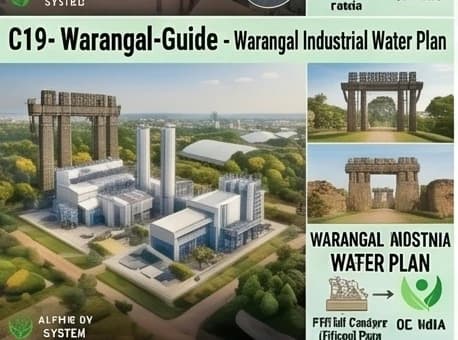
UV water treatment in Warangal addresses three key needs: (1) post-overhead-tank disinfection for Warangal's dense residential areas — WMC (Warangal Municipal Corporation) supply from Kakatiya Canal (drawing from Sriram Sagar and SRSP reservoir on the Godavari) loses residual chlorine in overhead tanks during Telangana's intense summer heat (temperatures reach 42–45°C in April–May in the Deccan plateau zone); (2) handloom and textile processing UV — Warangal's Pochampally Ikat and handloom weaving industry (concentrated in Bhoodan Pochampally, Nalgonda, and Yadadri zones, but with Warangal as the commercial hub) uses natural dye and chemical dye processing water requiring TSPCB compliance; and (3) pharmaceutical and granite industry UV at TSIIC industrial estates around Warangal, with TSPCB STP compliance for the Godavari basin. Alpha UV System supplies Philips UV-C lamp UV systems to Warangal with 5–7 day delivery and TSPCB documentation support.
Warangal — historically the capital of the Kakatiya dynasty (12th–14th century CE), builders of the Ramappa Temple (UNESCO World Heritage Site since 2021) and the intricate Kakatiya irrigation tank network — is Telangana's second city after Hyderabad. The Kakatiya tanks — a medieval irrigation system of 1,000+ interconnected water tanks — provided the foundation for Warangal district's traditional agriculture. The Kakatiya Canal, which brings Godavari water from SRSP (Sri Ram Sagar Project) reservoir, now supplies Warangal Municipal Corporation.
Warangal's economic identity centres on three sectors: (1) handloom weaving — Telangana is one of India's most important handloom states, with Pochampally Ikat silk sarees (GI-tagged, UNESCO Intangible Cultural Heritage recognised), double ikat, and cotton handlooms woven in the Warangal-Nalgonda corridor; (2) granite quarrying and processing — Telangana's Deccan traps contain black galaxy granite (highly valued in export markets), and Warangal district has significant granite quarrying activity; (3) growing pharmaceutical and chemical industry at TSIIC industrial estates.
Warangal Water Quality by Zone
| Zone / Area | Supply Type | Key Water Issue | UV Solution |
|---|---|---|---|
| Central Warangal / Hanamkonda (urban core) | WMC piped supply (Kakatiya Canal / Godavari) | Bacterial regrowth in 44°C Deccan summer; old distribution; supply intermittency in lean season; Godavari quality seasonal variation | Post-tank UV at 40 mJ/cm²; 5 µm pre-filter; April–May critical; monthly pre-filter check summer |
| TSIIC industrial estate (Warangal / Kazipet) | TSIIC supply + borewell | Pharmaceutical manufacturing; chemical processing; TSPCB STP compliance; Deccan basalt borewell (check iron) | Pharmaceutical UV (185+254 nm); TSPCB STP UV; Schedule M 2025; borewell iron check |
| Pochampally / Bhoodan handloom cluster | Borewell + municipal supply | Ikat dyeing — natural and chemical dye TSPCB ETP; Godavari basin discharge; export buyer sustainability audit | Natural dye process water UV; ETP UV-AOP for synthetic dye units; export sustainability documentation |
| Granite processing area (Warangal district) | Borewell + surface water | Granite cutting — silica dust slurry water; TSPCB STP; export quality granite washing water | Process water UV; worker potable UV; TSPCB STP UV; RO+UV if borewell TDS >500 mg/L |
| Khammam / Jangaon (satellite towns) | Municipal supply + borewell | Coal mining support town (Singareni Collieries nearby); agricultural market; borewell fluoride risk in hard Deccan granite zones | NABL fluoride test borewell; post-tank UV; TSPCB STP; coal miner township UV |
UV for Warangal's Pochampally Ikat Handloom Industry
Pochampally Ikat (Bhoodan Pochampally, approximately 40 km from Hyderabad but in the Warangal-Nalgonda corridor) is one of India's most celebrated handloom traditions — the complex resist-dyeing technique (where threads are dyed in the ikat pattern before weaving) produces Telangana's most prized silk and cotton textiles. The Pochampally and Nalgonda handloom cluster (which also includes Warangal's Koyyalagudem and Bhimadevarapalli weaving areas) exports Ikat textiles to Japan, Europe, and the USA.
Water in Pochampally Ikat processing: the yarn dyeing stage (where threads are dyed with plant-based natural dyes or synthetic reactive/acid dyes for silk) uses water extensively for dye bath preparation, rinsing, and mordanting. Natural dye ikat (turmeric, indigo, pomegranate rind mordanted with alum) is preferred for export to Japanese and European buyers who value traditional handloom processes — natural dye process water should be UV-treated (not chlorinated) because chlorine bleaches and degrades natural dye colours on contact.
Export sustainability audit requirements: Japanese textile importers (major Ikat buyers) and EU fashion brands purchasing Pochampally Ikat for their premium collections increasingly require sustainability audits that include water treatment and effluent management at the dyeing stage. UV treatment at the dye process water input and ETP final effluent UV for the few larger dyeing units satisfies these audit requirements and differentiates compliant Warangal handloom exporters in the international market.
| Application | Flow Rate | UV Dose | Notes |
|---|---|---|---|
| Residential apartment (Warangal / Hanamkonda) | 1–3 m³/h | 40 mJ/cm² | Post-overhead-tank UV; 5 µm pre-filter; Deccan April–May heat critical |
| Pochampally Ikat natural dye processing | 1–5 m³/h | 40 mJ/cm² | Natural dye process water (no chlorine — bleaches indigo/turmeric); FSSAI-adjacent quality; export audit |
| Handloom reactive dye ETP (synthetic dye units) | 5–20 m³/h | 1,500–3,000 mJ/cm² | UV-AOP with H₂O₂; TSPCB colour limit; Godavari basin discharge; sustainability audit documentation |
| Pharmaceutical purified water (TSIIC) | 2–10 m³/h | 80 mJ/cm² | 185 nm + 254 nm; Schedule M 2025 IQ/OQ/PQ; TSPCB documentation |
| Granite processing worker potable | 1–3 m³/h | 40 mJ/cm² | Factories Act worker water; quarry and cutting unit borewell UV; check iron and fluoride first |
| STP outlet — 300 KLD (Warangal residential) | 20–30 m³/h | 40 mJ/cm² | Philips TUV 95W; TSPCB consent documentation; Godavari basin compliance |
Warangal is on Deccan granite — is fluoride a concern in borewell water?
Yes — fluoride contamination in borewell water is a documented concern in parts of Telangana's Deccan plateau zone, including areas of Warangal, Nalgonda, and Khammam districts. Nalgonda district (adjacent to Warangal) is historically India's worst-affected fluorosis district, with borewell fluoride concentrations of 2–10 mg/L (the BIS permissible limit is 1.5 mg/L).
Critically: UV does NOT remove fluoride. UV is a disinfection technology — it inactivates bacteria and viruses but cannot remove any dissolved mineral, including fluoride. Fluoride removal requires specific treatment: activated alumina filters, defluoridation units, or Nalgonda technique (alum + lime treatment). For Warangal-zone borewell users: (a) get NABL-accredited borewell water testing for fluoride before installing any treatment system; (b) if fluoride exceeds 1.5 mg/L, install activated alumina or RO before the UV system; (c) UV then serves as the final microbiological disinfection step after fluoride removal. Do not assume UV handles all water quality parameters — have the water tested first.
Alpha UV System supplies UV disinfection systems to Pochampally Ikat handloom dyers, pharmaceutical manufacturers, granite processors, residential complexes, and STP operators across Warangal, Hanamkonda, TSIIC industrial estates, Kazipet, Khammam, and Godavari basin Telangana. TSPCB STP documentation. Natural dye process water UV. Schedule M 2025 pharma UV. Philips UV-C lamps. 5–7 day delivery to Warangal.
WhatsApp Us for Warangal UV System SupplyRecommended UV Systems
Alpha UV System products for this application — powered by genuine Philips UV-C lamps.
Commercial UV Water Purification System
500 – 5,000 LPH
HACCP-compliant UV water purification for hotels, restaurants, and offices
Industrial UV Water Treatment System
5,000 – 50,000 LPH
Schedule M 2025 and HACCP compliant UV for pharma, food & beverage, and process water
Not sure which system suits your application? WhatsApp our engineers for a free recommendation →