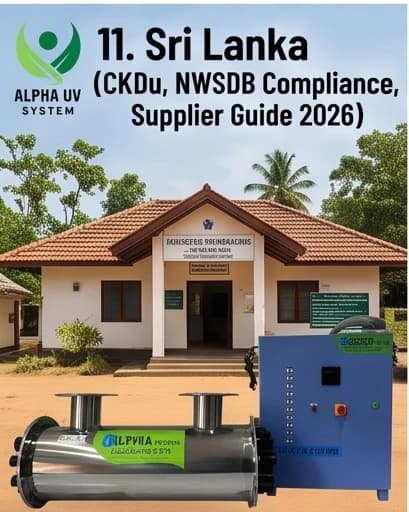
UV water treatment Sri Lanka installations require a minimum 40 mJ/cm² delivered dose for drinking water (Sri Lanka Standard SLS 614 aligned with WHO GDWQ) and 60 mJ/cm² for food contact applications. Sri Lanka's surface water (rivers and reservoirs) has UVT of 75–90% at 254 nm after conventional treatment — pre-filtration to 5 NTU turbidity is required before UV. Groundwater UVT varies from 80–95%. Alpha UV System ships CE-certified UV units from India to Colombo Port in 5–7 days by sea, or 2–3 days by air to Bandaranaike International Airport.
Sri Lanka's Water Quality Crisis: Why UV Is Essential
Sri Lanka's water treatment landscape is defined by two intersecting challenges that make UV water treatment Sri Lanka deployment both urgent and complex. The first is ubiquitous microbiological contamination: Sri Lanka's network of tanks, rivers, and reservoirs that supply the National Water Supply and Drainage Board (NWSDB) treatment works are persistently contaminated with E. coli, total coliforms, and enteric pathogens from agricultural runoff, inadequately treated sewage from small towns, and open defecation in rural areas. The NWSDB serves only 42% of the population with piped supply — the remainder depends on dug wells, tube wells, rainwater harvesting, and unregulated surface water sources with highly variable microbiological quality.
The second challenge is Chronic Kidney Disease of unknown aetiology (CKDu) — a devastating epidemic in Sri Lanka's North Central Province (Anuradhapura, Polonnaruwa) and parts of the North Western Province that has affected over 400,000 people. While the exact aetiology remains debated, WHO and Sri Lanka's Ministry of Health have identified elevated fluoride (>1.5 mg/L), hardness, and possible pesticide contamination in local groundwater as contributing factors. UV water treatment Sri Lanka CKDu-zone applications must be paired with RO or activated carbon filtration for fluoride and mineral reduction — UV alone addresses microbial contamination but not dissolved mineral load. This combination approach is being deployed through the Presidential Task Force on CKDu across 250 community water treatment centres.
Sri Lanka's drinking water standard SLS 614 (Specification for Drinking Water, 4th edition) aligns with WHO GDWQ (4th edition) — zero E. coli per 100 mL and zero total coliforms per 100 mL at the consumer tap. The Sri Lanka Accreditation Board (SLAB) and NWSDB's quality assurance division enforce these standards at utility level. For food processing facilities regulated by the Sri Lanka Standards Institution (SLSI) and the Ministry of Health, documented water treatment is a prerequisite for SLSI quality mark certification and factory licensing.
UV Dose Requirements for Sri Lanka's Diverse Water Sources
Sri Lanka's water UV transmittance varies significantly by source type and season — a critical factor in system sizing. Monsoon-season surface water in the Mahaweli, Kelani, and Kalu river systems turbidity spikes to 50–200 NTU during heavy rainfall, requiring multi-stage pre-treatment before UV. Dry-season treated reservoir supply from NWSDB's Ambatale and Biyagama plants has UVT of 85–90% at 254 nm. Groundwater in the lowland wet zone typically measures 88–93% UVT; hard groundwater in the dry zone North Central Province may be 80–88% UVT after softening.
| Pathogen | 3-log Inactivation (mJ/cm²) | 4-log Inactivation (mJ/cm²) | Prevalence in Sri Lanka |
|---|---|---|---|
| E. coli / faecal coliforms | 6.9 | 11.0 | Very high — agricultural runoff, open defecation |
| Vibrio cholerae | 0.65 | 1.0 | Periodic outbreak risk, especially post-monsoon |
| Cryptosporidium parvum | 2.5 | 5.8 | Northern livestock farming regions |
| Rotavirus (diarrhoeal disease) | 18.0 | 36.0 | Significant paediatric burden — hospitals, schools |
| Typhoid (Salmonella typhi) | 5.0 | 7.5 | Endemic in parts of North and East Sri Lanka |
For NWSDB-treated piped supply in Colombo and major cities, UV water treatment Sri Lanka point-of-use installations targeting 40 mJ/cm² provide an effective final-barrier polishing step. For rural well water and CKDu-zone community water stations, 60 mJ/cm² is recommended to handle higher bioburden and seasonal contamination spikes. Food processing and hotel applications in tourist zones (Galle, Kandy, Sigiriya, Mirissa, Trincomalee) require 60 mJ/cm² for food contact water under SLSI and Tourism Development Authority licensing.
CFD-Validated Reactors for Sri Lanka's Variable Water Quality
Sri Lanka's seasonal water quality variation — particularly turbidity and colour during the south-west monsoon (May–September) and north-east monsoon (October–January) — demands UV reactor designs with conservative hydraulic margins. Computational fluid dynamics (CFD) analysis in ANSYS Fluent confirms that Alpha UV System reactors achieve Reduction Equivalent Dose efficiency (EFF) >0.90 across the flow range at Sri Lanka's lowest expected UVT values. This means UV water treatment Sri Lanka systems deliver compliant 40 mJ/cm² dose even when monsoon-season coloured water temporarily reduces UVT to 75–78% — provided turbidity is controlled to <1 NTU upstream.
All Alpha UV System reactors include a real-time UVT-compensating UV intensity sensor. When UVT drops below the design basis (indicating seasonal water quality deterioration or pre-filter fouling), the controller automatically increases lamp output to maintain compliant dose delivery — and triggers an alarm if lamp power cannot compensate, alerting the operator to service the pre-filter. This active dose monitoring is essential for UV water treatment Sri Lanka monsoon-season reliability.
Key Industry Applications Across Sri Lanka
| Sector | Application | Typical Flow Rate | UV Dose | Compliance Standard |
|---|---|---|---|---|
| Tourism and Hotels | Building water, pool make-up, restaurant water | 3–50 m³/h | 40–60 mJ/cm² | SLS 614 / TDA hotel licence |
| Tea and Food Processing | Process water, boiler feed, CIP rinse | 5–100 m³/h | 60 mJ/cm² | SLSI factory licence / HACCP |
| Community Water Stations (CKDu) | Groundwater + RO permeate polishing | 1–5 m³/h | 40 mJ/cm² | Ministry of Health CKDu programme |
| Healthcare and Hospitals | Sterile water, dialysis, OR water | 2–20 m³/h | 60–80 mJ/cm² | Ministry of Health / JCI accreditation |
Sri Lanka's tourism sector is the primary commercial UV water treatment market. The country received 1.5 million tourists in 2023 and is targeting 3 million by 2026 under the Tourism Recovery Roadmap. International hotel chains (Marriott, Hilton, Shangri-La, Aman) and boutique properties in Galle Fort, Sigiriya, and Trincomalee operate under corporate brand standards requiring documented Legionella management and food contact water UV treatment. Sri Lanka Tourism Development Authority (TDA) star-grading inspections check water treatment compliance. UV water treatment Sri Lanka hotel installations eliminate the taste and odour issues associated with the high chlorine doses used in distribution.
Tea processing is a unique Sri Lankan application. Sri Lanka's 700+ tea factories — predominantly in the Hill Country (Nuwara Eliya, Kandy, Badulla, Ratnapura districts) — use process water in withering, fermentation, and final wash stages where microbiological contamination affects product quality and HACCP compliance. Sri Lanka's tea export quality is certified by the Sri Lanka Tea Board, and HACCP plans for export-grade tea manufacturing specify treated process water. UV water treatment Sri Lanka tea factories provide the necessary documentation for SLSI food mark and HACCP certification.
Apparel and export manufacturing in the Board of Investment (BOI) zones — Katunayake, Biyagama, Koggala, Seethawaka — use process water in fabric washing, dyeing, and finishing. Wastewater treatment UV disinfection (30–40 mJ/cm²) is specified in Sri Lanka's National Environmental Act discharge standards for treated effluent in the textile sector.
Importing UV Systems from India to Sri Lanka
Sri Lanka is one of the shortest and easiest sea freight routes from India. Alpha UV System ships from JNPT (Mumbai) or Chennai Port to Colombo Port — one of South Asia's busiest transshipment hubs. Sea freight takes just 5–7 days from Chennai (direct service), making Sri Lanka one of Alpha UV System's fastest export routes. Air freight via Bandaranaike International Airport (Katunayake) delivers urgent orders in 2–3 days. Sri Lanka Customs operates a reasonably efficient clearance process with typical 3–5 business day clearance for commercial shipments.
| Document | Purpose | Sri Lanka Notes |
|---|---|---|
| Commercial Invoice | Customs valuation, HS 8421.29.90 | State CIF Colombo value; Sri Lanka Customs uses CIF as duty basis |
| Packing List | Itemised contents with weights | Include lamp quantities — Sri Lanka Customs may separately assess lamps |
| Bill of Lading / Airway Bill | Title and freight document | Consign to Sri Lanka-registered importer |
| Certificate of Origin (SAFTA Form) | Preferential duty under SAFTA | India-Sri Lanka SAFTA provides zero or reduced duty on eligible goods — verify HS 8421.29 eligibility |
| CE Declaration of Conformity | SLS / SLSI electrical compliance | SLSI accepts CE as primary electrical safety evidence |
| NSF/ANSI 55 Class A Test Report | SLSI and MoH performance evidence | Required for food factory SLSI certification and hospital compliance |
Sri Lanka's import duty on water treatment equipment (HS 8421.29) is typically 0–15% depending on classification and any SAFTA preferential treatment. Sri Lanka charges a 15% VAT on imports plus a 2.5% Social Security Contribution Levy (SSCL). Under the South Asian Free Trade Agreement (SAFTA), Indian-origin goods with a valid SAFTA Certificate of Origin may qualify for reduced or zero duty — consult your Sri Lanka customs agent for current tariff treatment under SAFTA Schedule. Alpha UV System provides SAFTA-compliant Certificates of Origin from the Export Inspection Council, India.
SLS Standards and Certifications for UV Water Treatment Sri Lanka
- SLS 614 (Drinking Water Standard): Sri Lanka's national drinking water standard — zero E. coli, zero total coliforms, HPC <500 CFU/mL. UV systems must demonstrate dose delivery sufficient to meet these limits
- SLSI Mark (Quality Mark): SLSI factory licences for food and beverage manufacturers require HACCP plans with documented water treatment — NSF/ANSI 55 Class A is the accepted UV performance standard
- CE Marking: accepted by SLSI as the primary electrical safety certification for imported UV equipment
- ISO 9001:2015: Alpha UV System's quality management certification — recognised in Sri Lanka government and BOI zone procurement processes
- SLAB Accreditation: for pharmaceutical water applications, SLAB-accredited water testing before and after UV installation is recommended to satisfy Ministry of Health pharmaceutical GMP requirements
Sizing Guide: Alpha UV Systems for Sri Lanka
| Application | Flow Rate | UV Dose | Alpha UV Series | Pre-filter Required |
|---|---|---|---|---|
| Home / community well (dry zone) | 0.5–2 m³/h | 40 mJ/cm² | Residential | 5-micron sediment |
| CKDu community water station | 1–5 m³/h | 40 mJ/cm² | Residential / Commercial | RO + 5-micron post |
| Hotel / guesthouse | 3–30 m³/h | 40–60 mJ/cm² | Commercial | 5-micron sediment |
| Tea factory / food processing | 5–100 m³/h | 60 mJ/cm² | Commercial / Industrial | Multimedia + 20-micron |
| Hospital / clinic | 2–20 m³/h | 60–80 mJ/cm² | Commercial | 5-micron sediment |
| BOI export factory | 10–200 m³/h | 30–60 mJ/cm² | Industrial | Multimedia + 20-micron |
Alpha UV System's IIT-trained engineers calculate every UV water treatment Sri Lanka system using actual source water UVT data. We recommend a free pre-installation water quality test — turbidity, UVT at 254 nm, iron, and manganese — for all Sri Lanka orders to ensure correct pre-filtration and UV sizing. Replacement Philips UV-C lamps and spare parts ship from India to Sri Lanka in 5–7 days by sea or 2–3 days by air, supporting low-downtime operations. WhatsApp our engineers for a free consultation and quote.
Frequently Asked Questions — UV Water Treatment Sri Lanka
Can UV water treatment help in CKDu-affected areas of Sri Lanka?
UV water treatment Sri Lanka CKDu zone applications address the microbiological component of water quality but not the dissolved mineral contaminants (fluoride, hardness, cadmium) implicated in CKDu aetiology. The recommended approach for CKDu community water stations is: multimedia filtration → RO (removes fluoride, minerals, and heavy metals) → UV polishing of RO permeate (kills any bacteria that pass through RO membrane pinholes). This combination is deployed across 250+ community water treatment centres in Anuradhapura and Polonnaruwa under Sri Lanka's Ministry of Health CKDu Mitigation Programme. Alpha UV System supplies both RO post-treatment UV and standalone UV units for this application.
Does SAFTA reduce import duty on UV systems from India to Sri Lanka?
Under the South Asian Free Trade Agreement (SAFTA), Indian-manufactured goods with a valid SAFTA Certificate of Origin (issued by India's Export Inspection Council) may qualify for reduced or zero import duty when imported into Sri Lanka. UV water treatment equipment (HS 8421.29.90) may be eligible — the duty rate depends on Sri Lanka's SAFTA Sensitive List and current bilateral tariff schedule. Alpha UV System provides SAFTA Certificates of Origin with all Sri Lanka orders. Consult your Sri Lanka-registered customs agent to confirm the current applicable duty rate for your specific shipment before ordering.
What turbidity level does Sri Lanka's water need to be before UV treatment?
UV water treatment Sri Lanka systems require source water turbidity below 1 NTU immediately before the UV reactor for reliable dose delivery. NWSDB-treated piped supply in Colombo and major cities typically measures <0.5 NTU — no pre-filtration needed. Groundwater from dug wells and tube wells in rural areas may require a 5-micron sediment cartridge filter upstream. Surface water from rivers and tanks — particularly during monsoon season (turbidity 50–500 NTU) — requires multimedia filtration and 20-micron cartridge filtration before UV. Alpha UV System can supply integrated pre-filtration + UV package systems for Sri Lanka rural and tea plantation installations.
How fast can Alpha UV System deliver to Sri Lanka?
Sea freight from Chennai Port to Colombo Port takes just 5–7 days — one of the fastest India-South Asia export routes. From JNPT (Mumbai), sea transit is 7–9 days. Add 3–5 business days for Sri Lanka Customs clearance and local delivery to site: total 10–14 days door-to-site from India. For urgent UV water treatment Sri Lanka orders (failed inspection, equipment breakdown), Alpha UV System air freights compact commercial-series units via Bandaranaike International Airport with delivery in 2–3 days. Replacement Philips UV-C lamps for existing systems ship air freight within 24–48 hours of order.
Are UV systems effective against cholera and typhoid risk in Sri Lanka?
Yes. UV water treatment Sri Lanka is highly effective against cholera (Vibrio cholerae) and typhoid (Salmonella typhi) — both are bacteriological pathogens that are inactivated at UV doses well below the standard 40 mJ/cm² target. V. cholerae is inactivated at just 0.65 mJ/cm² for 3-log reduction; S. typhi at approximately 5 mJ/cm² for 3-log reduction. A correctly installed and maintained UV system operating at 40 mJ/cm² provides essentially complete elimination of both pathogens from treated water. This makes UV especially valuable in Sri Lanka's North and East provinces where periodic cholera and typhoid outbreaks occur following floods or contamination events.
Recommended UV Systems
Alpha UV System products for this application — powered by genuine Philips UV-C lamps.
Commercial UV Water Purification System
500 – 5,000 LPH
HACCP-compliant UV water purification for hotels, restaurants, and offices
Industrial UV Water Treatment System
5,000 – 50,000 LPH
Schedule M 2025 and HACCP compliant UV for pharma, food & beverage, and process water
Not sure which system suits your application? WhatsApp our engineers for a free recommendation →